
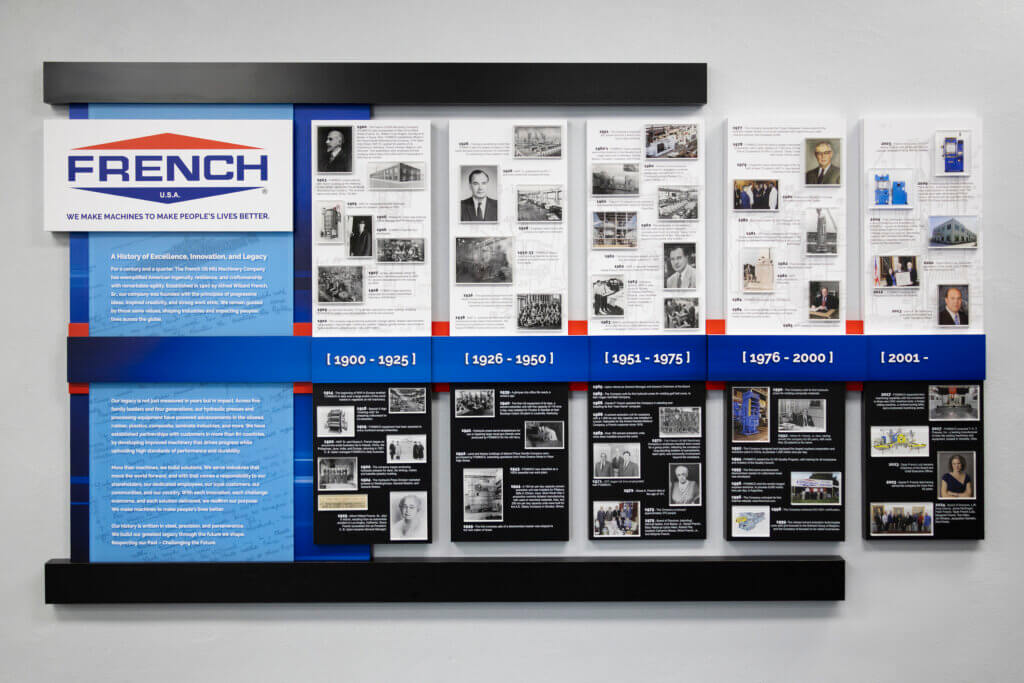
The French Museum: 125 Years of Innovation
A History of Excellence, Innovation, and Legacy
For a century and a quarter, The French Oil Mill Machinery Company has exemplified American ingenuity, resilience, and craftsmanship with remarkable agility. Established in 1900 by Alfred Willard French, Sr., our company was founded with the principles of progressive ideas, inspired creativity, and strong work ethic. We remain guided by those same values, shaping industries and impacting peoples’ lives across the globe.
Our legacy is not just measured in years but in impact. Across five family leaders and four generations, our hydraulic presses and processing equipment have powered advancements in the oilseed, rubber, plastics, composite, laminate industries, and more. We have established partnerships with customers in more than 80 countries, by developing improved machinery that drives progress while upholding high standards of performance and durability.
More than machines, we build solutions. We serve industries that move the world forward, and with that comes a responsibility to our shareholders, our dedicated employees, our loyal customers, our communities, and our country. With each innovation, each challenge overcome, and each solution delivered, we reaffirm our purpose: We make machines to make people's lives better.
Our history is written in steel, precision, and perseverance. We build our greatest legacy through the future we shape. Respecting our Past – Challenging the Future.
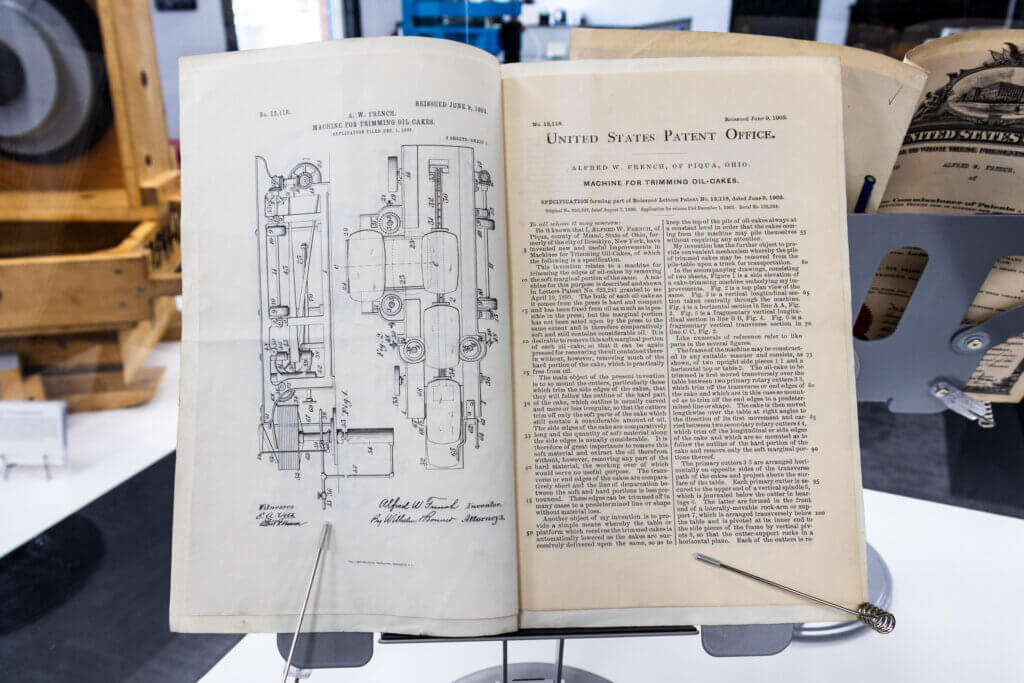
The 1903 Patent That Shaped an Industry
Awarded in 1903, U.S. Patent No. 12,118 marked a breakthrough invention by Alfred W. French Sr., founder of The French Oil Mill Machinery Company. His mechanical innovation significantly improved the efficiency of expressing oil from seed cakes during a period when the vegetable oil industry was shifting from manual to mechanized production. His design helped standardize oil cake formation and regulate hydraulic pressure, key advancements that were soon widely adopted throughout the linseed and cottonseed oil industries. This patent not only reflects Mr. French’s engineering ingenuity but also represents the foundational moment in the legacy of a company that would help shape oilseed processing around the world for generations to come.
AWF Sr. Patent - 1902.001.01
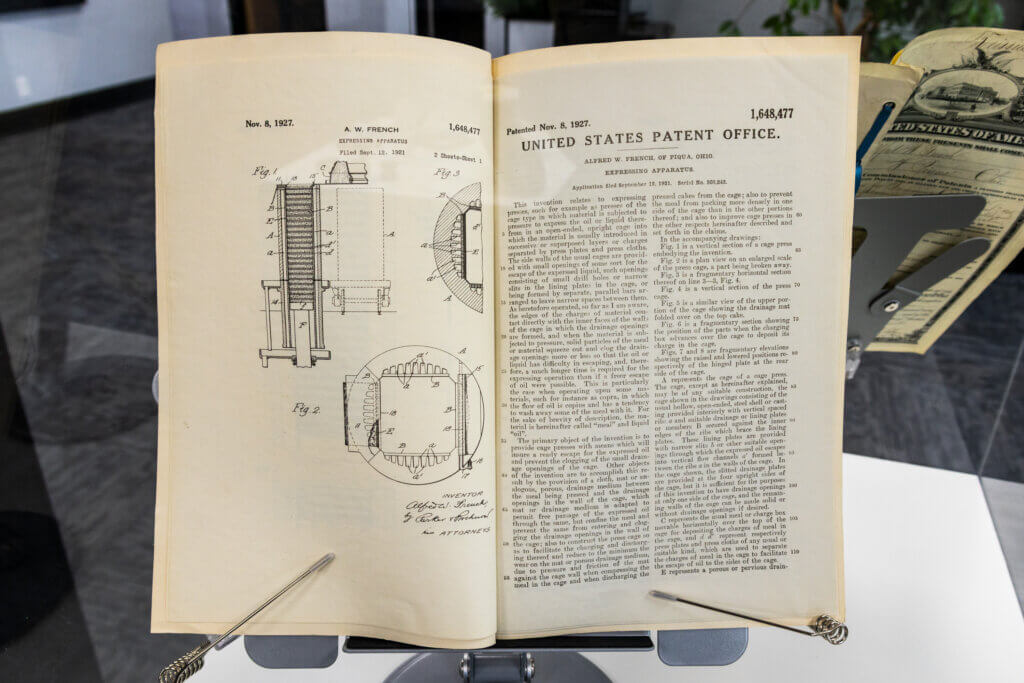
Patent That Transformed Oilseed Extraction
This original 1927 patent (U.S. Patent No. 1,648,477), awarded to Alfred W. French Jr., represents a significant advancement in the continuous mechanical extraction of oil from seeds and other oil-bearing materials. The “expressing apparatus” outlined in this design enhanced the efficiency, consistency, and overall performance of screw presses used in oilseed processing. Building upon the foundation laid by his father, company founder Alfred W. French Sr., this invention reflects the next generation’s contribution to improving essential industrial processes. This patent remains a symbol of French’s continued innovation during a pivotal era of industrial growth and technological advancement in oilseed processing.
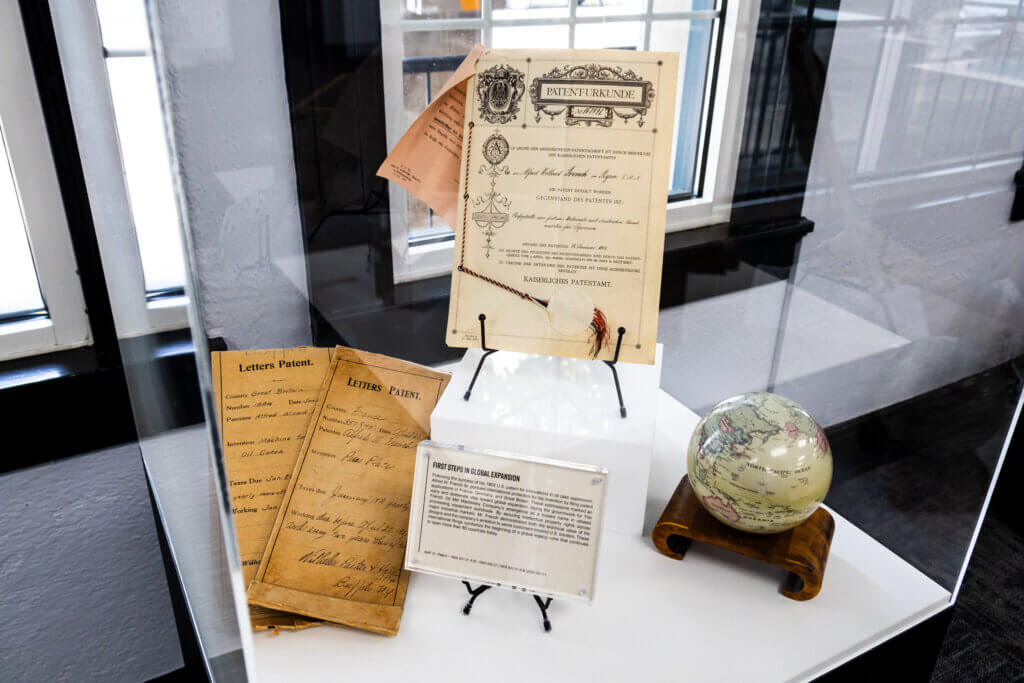
First Steps in Global Expansion
Following the success of his 1903 U.S. patent for innovations in oil cake expression, Alfred W. French Sr. pursued international protection for his invention by filing patent applications in France, Germany, and Great Britain. These submissions marked an early and deliberate step toward global expansion, laying the groundwork for The French Oil Mill Machinery Company’s emergence as a trusted name in oilseed processing equipment worldwide. By securing intellectual property rights across major industrial markets, Mr. French demonstrated both the technical value of his designs and the company’s ambition to serve customers beyond U.S. borders. These international filings symbolize the beginning of a global legacy—one that continues to span more than 80 countries today.
AWF Sr. Patent – 1905.001.01 A-B | 1905.002.01 | 1905.003.01 A-B | 2000.001.01
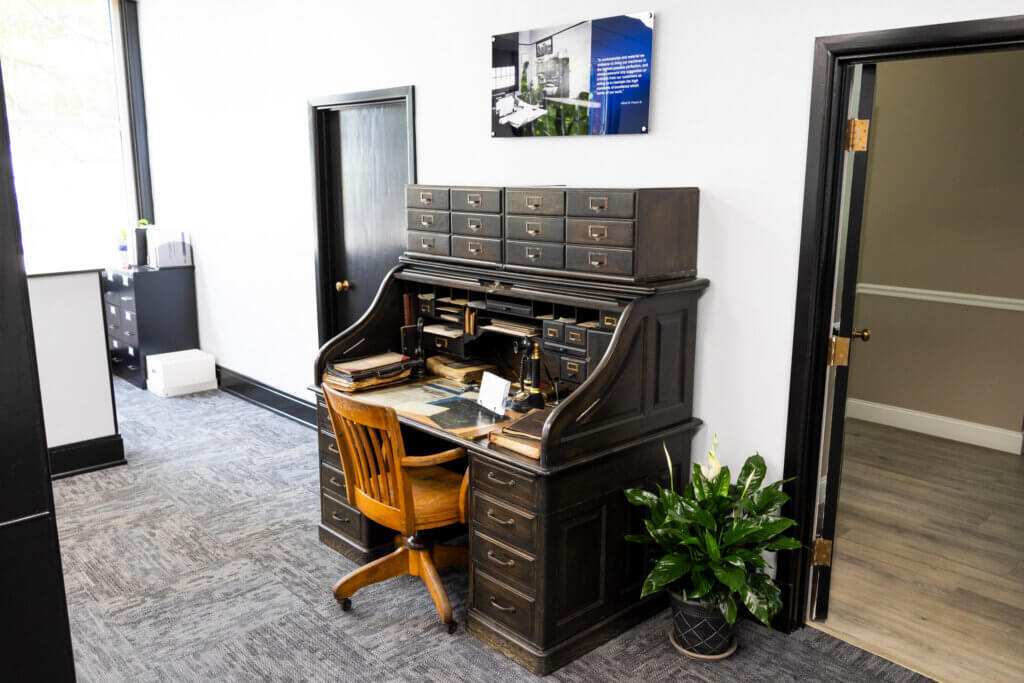
The Founder's Desk
More than a piece of furniture, this desk is a preserved link to the early years of The French Oil Mill Machinery Company and to the engineer whose vision helped shape a global industry. From this desk, Alfred Willard French Sr. developed groundbreaking ideas—among them, patents for a linseed cake trimmer and an automatic hydraulic valve that became standards in oilseed processing. The surface is arranged with original artifacts that reflect the focused rhythm of his work: ledgers tracking early sales, contracts and international documents, handwritten letters, a rotary phone, a slide rule, and a desk calendar. Together, they offer a glimpse into the daily life of a meticulous and forward-thinking inventor. What began as a visit in 1897 to troubleshoot machinery quietly became the starting point of something far greater: a legacy that would span generations and reach customers around the world.
AWF Sr. Roll Top Desk - 1900.001.01
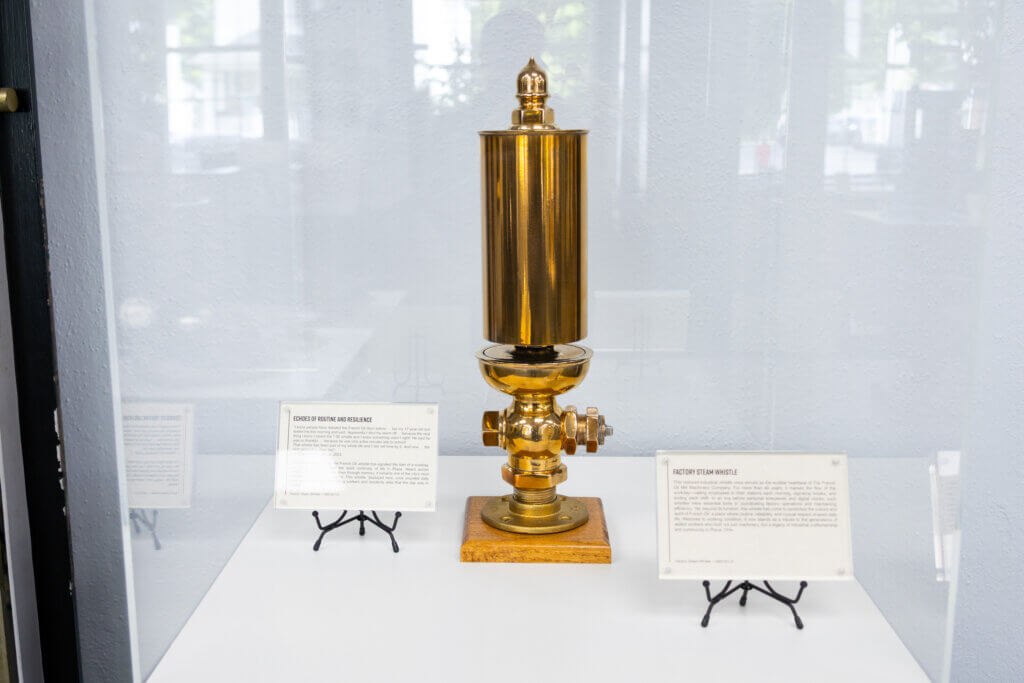
Echoes of Routine and Resilience
“I know people have debated the French Oil Horn before … but my 17-year-old son texted me this morning and said, ‘Apparently I shut my alarm off … because the next thing I know I heard the 7:30 whistle and I knew something wasn’t right!’ He said he was so thankful … because he was only a few minutes late to school!
That whistle has been part of my whole life and I still ‘tell time by it.’ And now … the next generation does too!”
— Shared on Facebook, 2023
For more than a century, the French Oil whistle has signaled the start of a workday, the passing of time, and the quiet continuity of life in Piqua. Heard across neighborhoods and passed down through memory, it remains one of the city’s most familiar—and beloved—sounds. This whistle, displayed here, once sounded daily from the factory roof, reminding workers and residents alike that the day was in motion.
Factory Steam Whistle – 1900.001.01
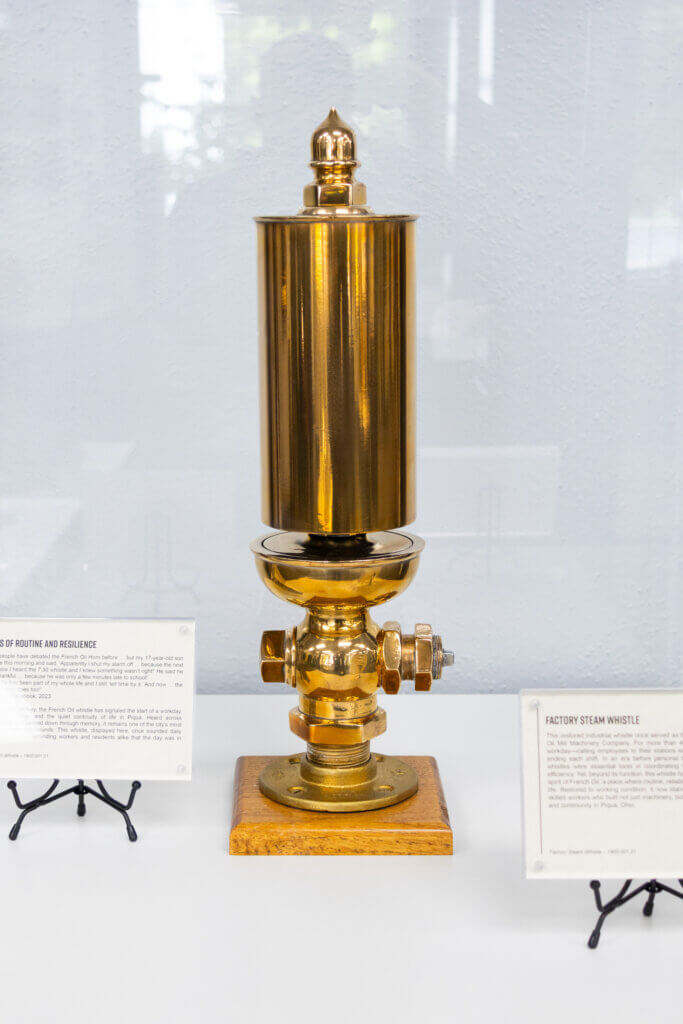
Factory steam whistle
This restored industrial whistle once served as the audible heartbeat of The French Oil Mill Machinery Company. For more than 40 years, it marked the flow of the workday—calling employees to their stations each morning, signaling breaks, and ending each shift. In an era before personal timepieces and digital clocks, such whistles were essential tools in coordinating factory operations and maintaining efficiency. Yet, beyond its function, this whistle has come to symbolize the culture and spirit of French Oil: a place where routine, reliability, and mutual respect shaped daily life. Restored to working condition, it now stands as a tribute to the generations of skilled workers who built not just machinery, but a legacy of industrial craftsmanship and community in Piqua, Ohio.
Factory Steam Whistle – 1900.001.01
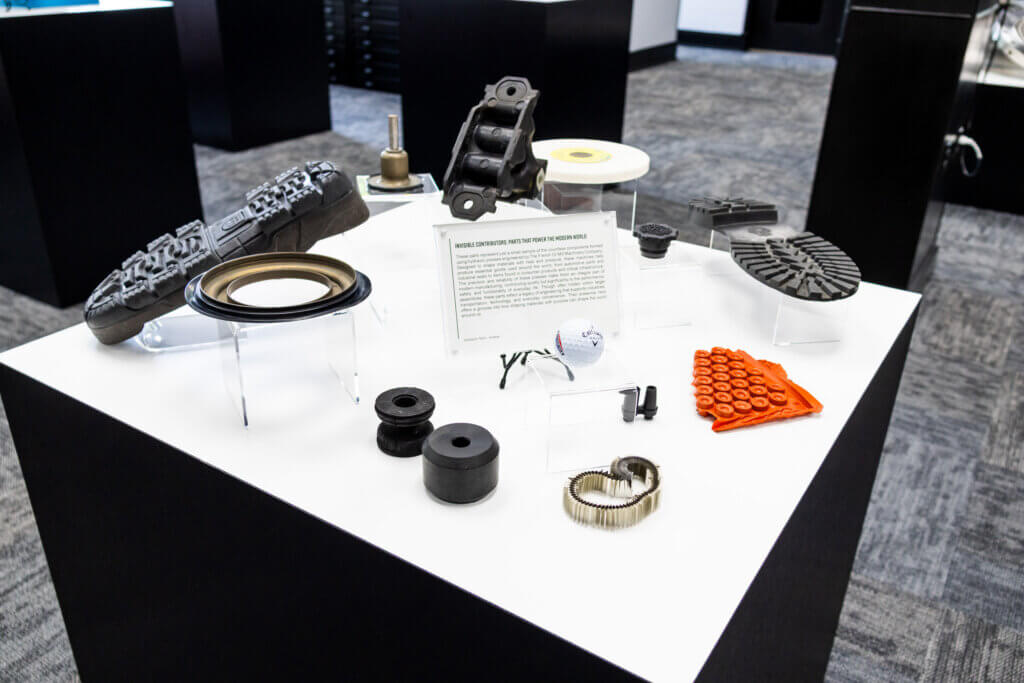
Invisible Contributors: Parts That Power the Modern World
These parts represent just a small sample of the countless components formed using hydraulic presses engineered by The French Oil Mill Machinery Company. Designed to shape materials with heat and pressure, these machines help produce essential goods used around the world, from automotive parts and industrial seals to items found in consumer products and critical infrastructure. The precision and reliability of these presses make them an integral part of modern manufacturing, contributing quietly but significantly to the performance, safety, and functionality of everyday life. Though often hidden within larger assemblies, these parts reflect a legacy of engineering that supports industries, transportation, technology, and everyday convenience. Their presence here offers a glimpse into how shaping materials with purpose can shape the world around us.
Hydraulic Parts - multiple
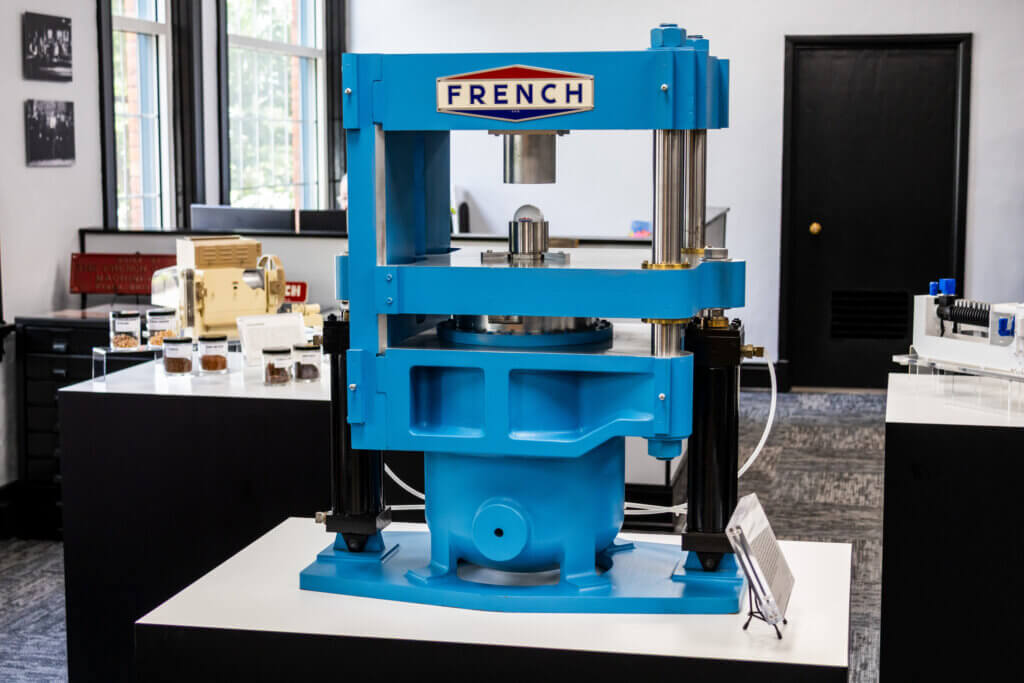
Hydraulic Press for Golf Ball Molding
This model represents an up-acting hydraulic press used in the production of Callaway golf balls. The left side shows an example of sideplate construction and the right side shows the four-post or column construction option. The open-front “C” design allows easy access for loading and unloading molds, making it ideal for precision applications where frequent part handling is required. In this case, the press is used to mold golf ball components under tightly controlled pressure and temperature conditions—ensuring consistent shape, weight, and performance. The up-acting motion of the press platen provides a smooth, even force critical to forming the durable outer layers of the ball. This type of press exemplifies the precision and repeatability needed in sporting goods manufacturing, where product consistency can directly impact performance on the field—or in this case, the course.
Hydraulic Press – 1983.001.01
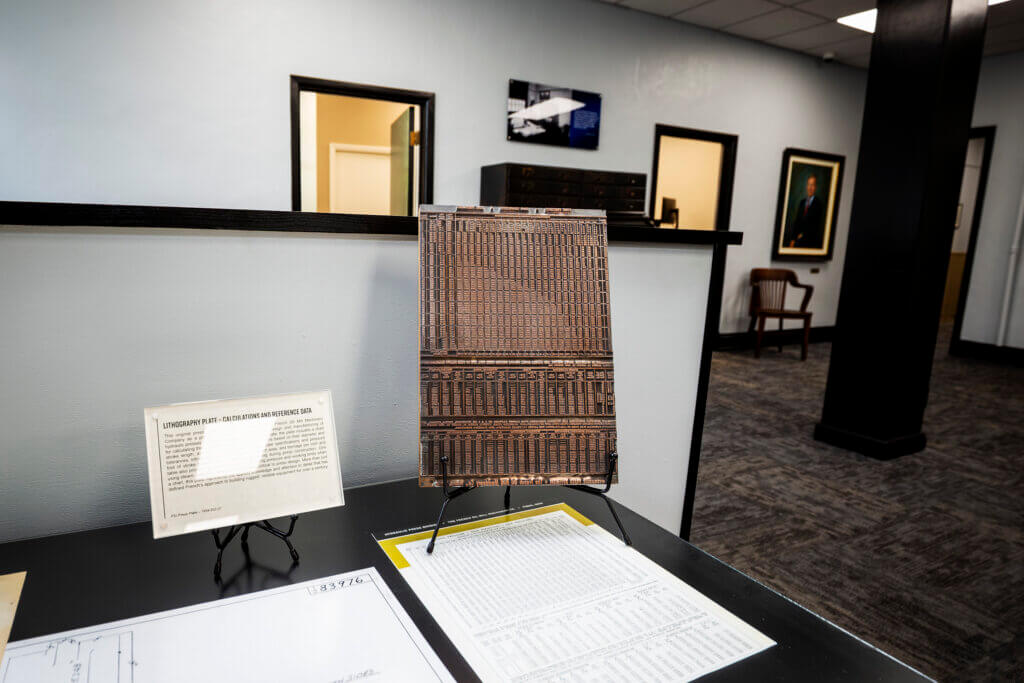
Lithography Plate – Calculations and Reference Data
This original press plate was used in-house at The French Oil Mill Machinery Company as a practical reference tool during the design and manufacturing of hydraulic presses. Etched with detailed engineering data, the plate includes a chart for calculating the pressure exerted by hydraulic rams based on their diameter and stroke length, as well as tables related to steel pipe specifications and pressure tolerances. Information such as line pressure, ram area, and tonnage per inch and foot of stroke helped ensure precise engineering during press construction. One table also provides guidance on ultimate bursting pressure and working limits when using steam, reflecting safety considerations critical to press design. More than just a chart, this plate represents the applied knowledge and attention to detail that has defined French’s approach to building rugged, reliable equipment for over a century.
PSI Press Plate – 1954.002.01
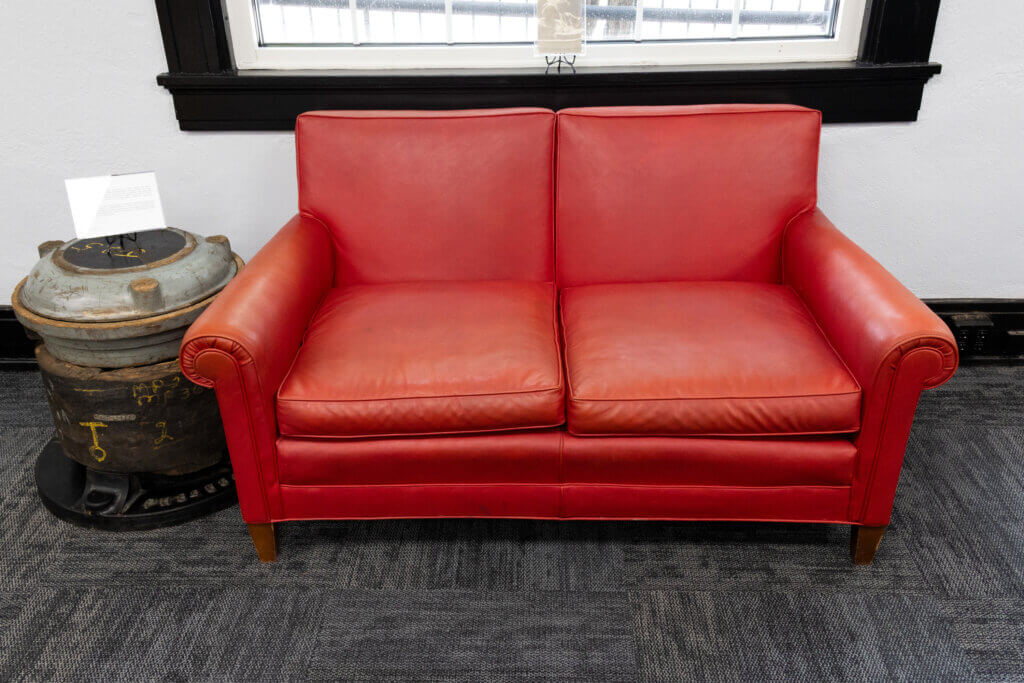
Lipstick Red Loveseat
This striking mid-century loveseat, upholstered in vibrant lipstick red fabric, exemplifies the bold aesthetic of 1960s American design. Its compact form and clean lines reflect the era's emphasis on both style and functionality. The piece was manufactured by the Shaw Furniture Company, a historic firm founded in 1780 in Cambridge, Massachusetts, known for its high-quality custom and production furniture.
This particular loveseat was custom-ordered by Marjorie French as a gift for her husband, Alfred W. French Jr., then President of The French Oil Mill Machinery Company. Though originally intended for personal use, the loveseat eventually made its way to the French headquarters, where it now serves as a vibrant artifact of family heritage and enduring craftsmanship.
Loveseat – 1960.001.01
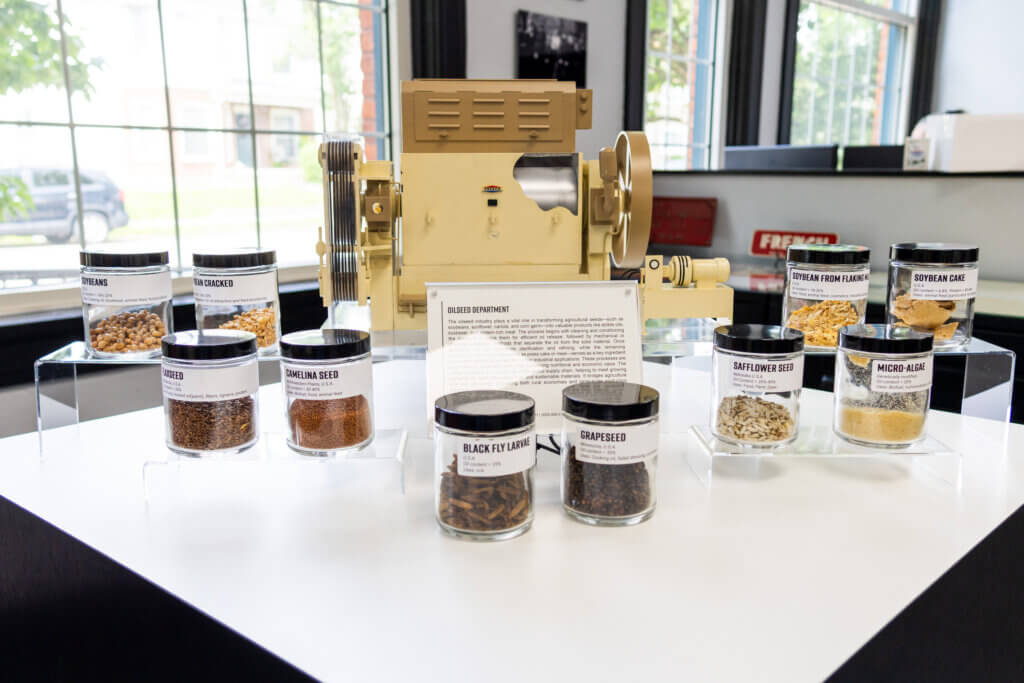
Oilseed Department
The oilseed industry plays a vital role in transforming agricultural seeds—such as soybeans, sunflower, canola, and corn germ—into valuable products like edible oils, biodiesel, and protein-rich meal. The process begins with cleaning and conditioning the seeds to prepare them for efficient oil release, followed by mechanical or chemical extraction methods that separate the oil from the solid material. Once extracted, the oil undergoes clarification and refining, while the remaining byproduct—commonly referred to as press cake or meal—serves as a key ingredient in livestock feed or as a base for further industrial applications. These processes are engineered to maximize yield while preserving nutritional and economic value. The oilseed industry is a crucial link in the global supply chain, helping to meet growing demands for food, renewable fuel, and sustainable materials. It bridges agriculture with manufacturing, supporting both rural economies and large-scale production industries worldwide.
Oilseed– 2024.001.01 | 2024.002.01 | 2024.003.01 | 2024.004.01 | 2024.005.01 | 2024.006.01
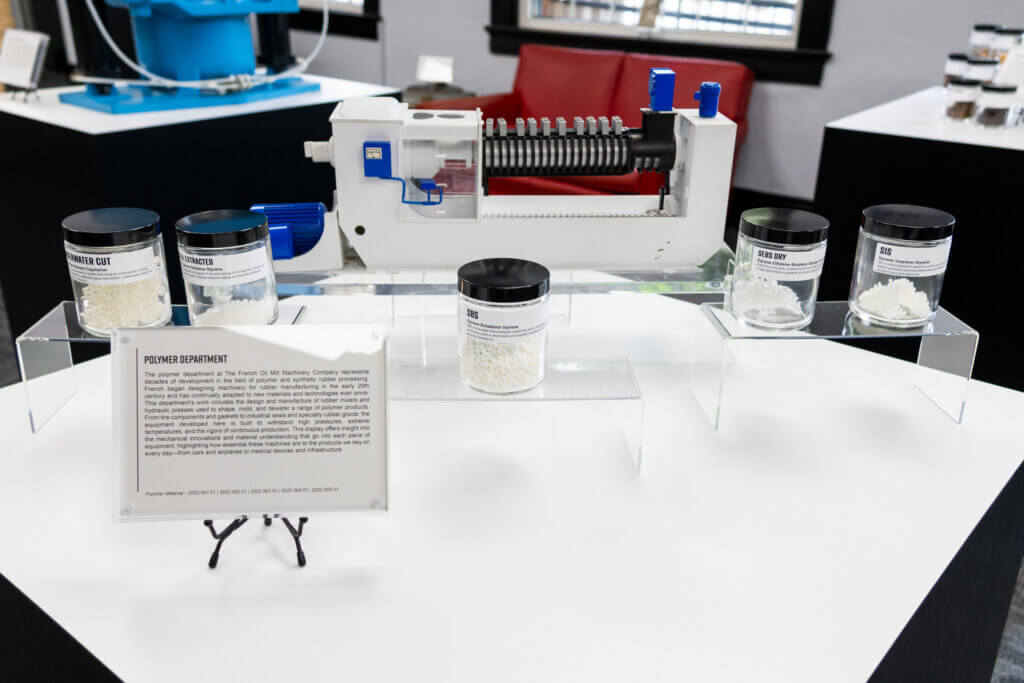
Polymer Department
The polymer department at The French Oil Mill Machinery Company represents decades of development in the field of polymer and synthetic rubber processing. French began designing machinery for rubber manufacturing in the early 20th century and has continually adapted to new materials and technologies ever since. This department’s work includes the design and manufacture of rubber mixers and hydraulic presses used to shape, mold, and dewater a range of polymer products. From tire components and gaskets to industrial seals and specialty rubber goods, the equipment developed here is built to withstand high pressures, extreme temperatures, and the rigors of continuous production. This display offers insight into the mechanical innovations and material understanding that go into each piece of equipment, highlighting how essential these machines are to the products we rely on every day—from cars and airplanes to medical devices and infrastructure.
Polymer Material – 2022.001.01 | 2022.002.01 | 2022.003.01 | 2022.004.01 | 2022.005.01
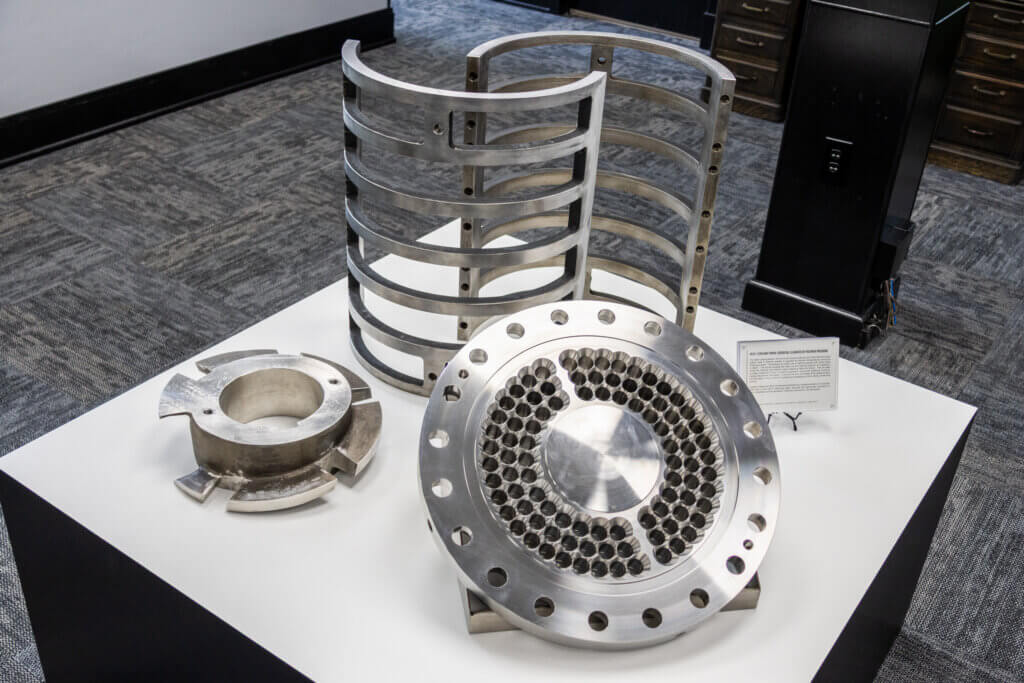
Heat, Flow and Finish: Essential Elements of Polymer Pressing
The water cooling sleeves, the worms and the die plate are part of the thermal control system used in polymer presses to regulate the polymer temperatures during the finishing process. The sleeves can either cool or heat the polymer with chilled water or steam. The worms squeeze the water out and heat the polymer by kneading it inside the machine, the notches impart additional heat with friction. The die plate provides resistance to flow to control compression along with additional drying by heating the polymer with steam. It controls the size and shape of the pellets as they exit the press, which is critical for additional processing and the molding of the final product.
Together, these and other components illustrate how multiple elements of a polymer press play a vital role in delivering clean, accurate and high-quality polymers for many industries such as recreation, medicine, automotive, and aerospace.
Polymer Material – 2022.001.01 | 2022.002.01 | 2022.003.01 | 2022.004.01 | 2022.005.01
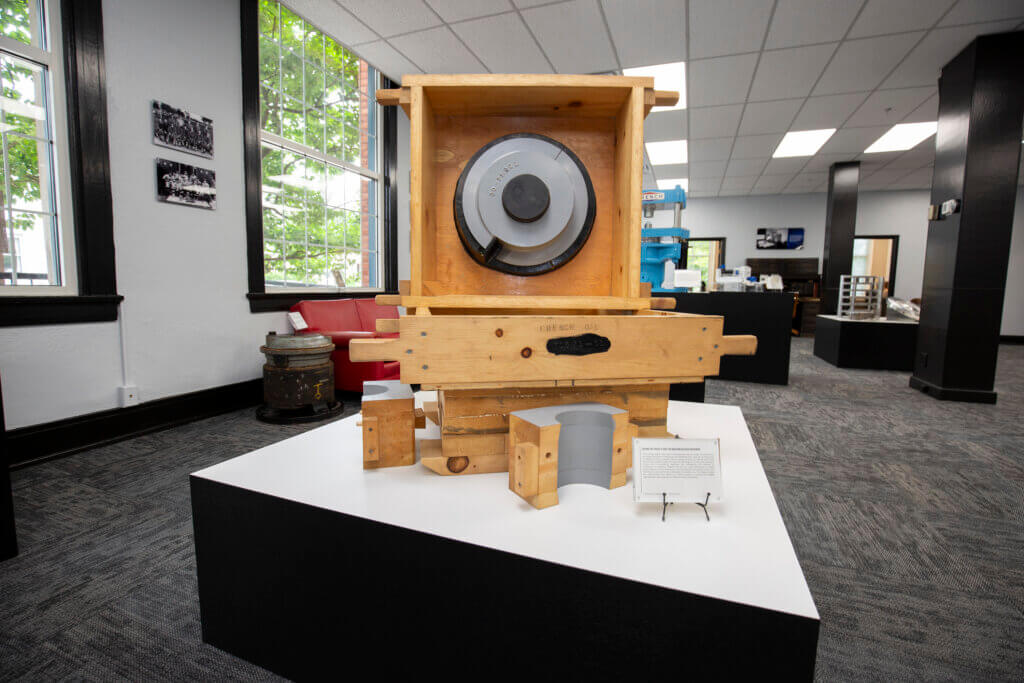
Behind the Press: A Tool for Building Oilseed Equipment
This wooden pattern was used in the casting process to create components for the oilseed department, specifically the discharge worm bearing housings used in mechanical screw presses.These housings support the rotating worm shaft that conveys pressed material through the discharge end of the press, playing a crucial role in maintaining alignment and withstanding the stresses of continuous oil extraction. Patterns like this one were handcrafted by skilled patternmakers to exact dimensions, ensuring that the final castings would meet the structural and performance demands of industrial use. This display reflects the craftsmanship and attention to detail required to produce the durable; high-precision parts essential to efficient oilseed processing.
Discharge Worm Bearing Pattern - 1995.001.01 A-B
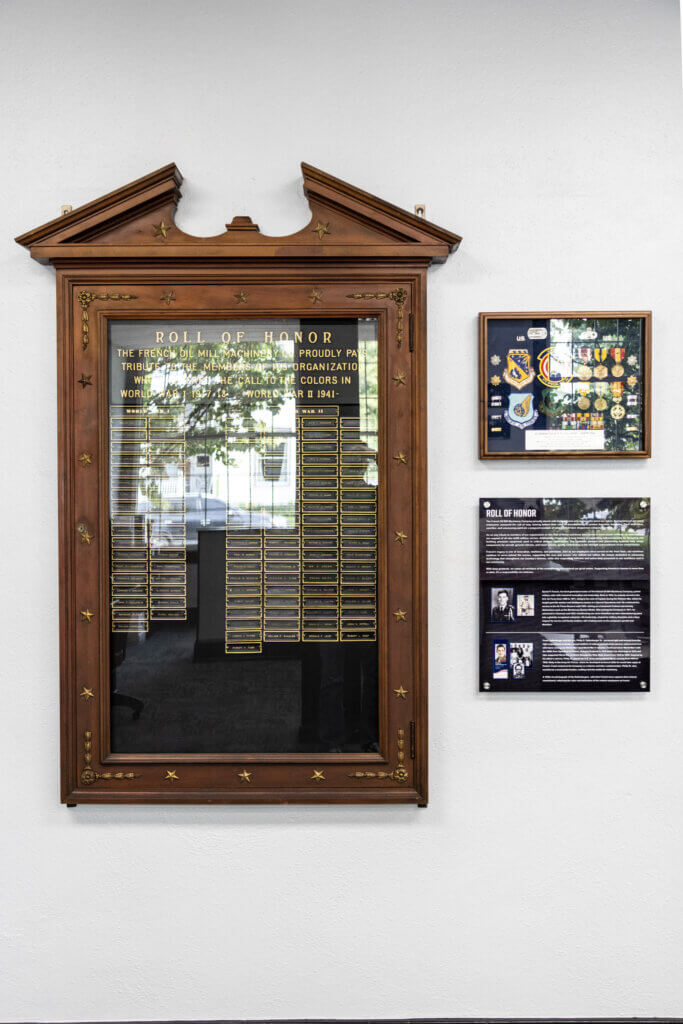
Roll of Honor
The French Oil Mill Machinery Company proudly stands with the brave men and women who serve our nation. During times of war many employees answered the call of duty, leaving behind their roles in manufacturing to protect American freedoms. Their dedication, sacrifice, and unwavering spirit are a poignant example of values which have shaped our company’s culture.
As we pay tribute to members of our organization on this Roll of Honor and those who served in more recent conflicts, we also reaffirm our support of all who fulfill military service. Additionally, French has a long history of supporting national security by designing and building precision equipment used in critical defense applications. Our hydraulic presses and processing systems help shape components for aircraft, ground vehicles, and naval vessels, quietly contributing to the strength and readiness of our armed forces.
French’s legacy is one of innovation, resilience, and patriotism. Just as our employees once served on the front lines, our machines continue to serve behind the scenes, supporting the men and women who defend our nation. We remain dedicated to advancing technology that strengthens our country’s defense, while also supporting veterans and active-duty personnel in our workforce and in our community.
With deep gratitude, we salute all members of the armed forces who defend our great nation. Supporting America’s heroes is more than a value, it’s a responsibility we embrace.

Roll of Honor | Daniel P. French
Daniel P. French, the third-generation leader of Piqua’s The French Oil Mill Machinery Company, paired military valor with industrial innovation. Born in 1943, he served in the U.S. Air Force from 1966 to 1971, earning the rank of Captain during the Vietnam War, where he taught guerrilla warfare and intelligence tactics in a Special Operations unit. Later, as a Lieutenant Colonel in the Air Force Reserve until 1994, he amassed honors like the Meritorious Service Medal. Joining The Company in 1971, he rose to Chairman and CEO, guiding the company—once a WWII supplier—into global prominence, blending his Air Force-honed leadership with a family legacy.
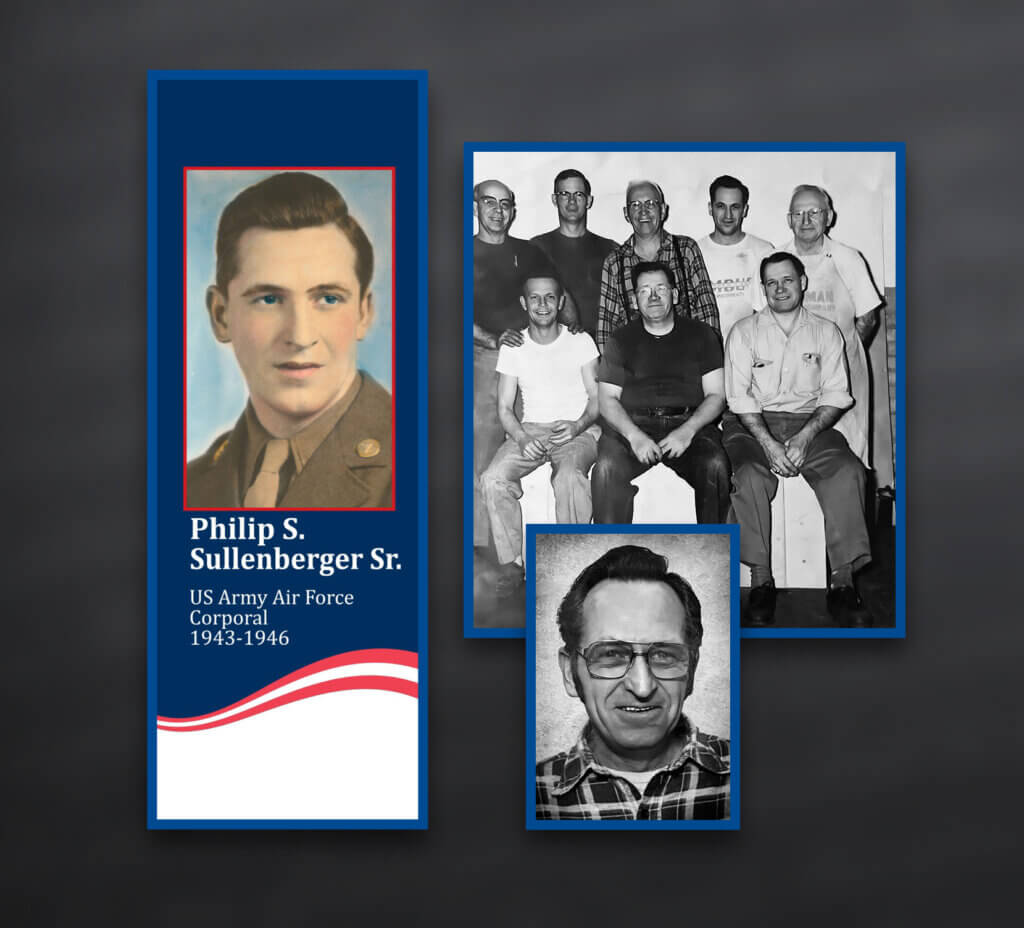
Roll Of Honor | The Sullenberger Family
Frank Sullenberger (group back right) and his son, Philip S. Sullenberger Sr., (group back second from the right) embody a proud tradition of military service and industrial excellence, represented here with honor among our World War I and World War II veterans. Frank served in World War I with the 485th Aero Squadron in France, rising to Corporal in 1918 before his discharge in 1919 and later supported World War II efforts through the Ohio State Guard from 1942 to 1943.
Inspired by his father’s service, Philip Sr. joined the U.S. Army during World War II, serving from 1943 to 1946, likely in the Army Air Forces, where he developed technical skills he would later apply at French. Frank worked at the Company as a laborer and later a patternmaker, while Philip Sr. excelled as a wood patternmaker, crafting intricate molds for machinery. A 1951–1952 photograph of them with their French team captures their shared commitment, reflecting the valor and dedication of the veteran employees honored here.
A World of Reasons

The French Oil Mill Machinery Company’s growth and global reach are rooted in bold visions and pioneering journeys. With equipment supplied to over 80 countries, our legacy of international partnership continues to shape our worldwide presence. We began exporting equipment to Canada, Great Britain, Germany, and Norway in 1908, demonstrating that our founder, A. W. French, Sr., recognized the significance of thinking globally from the beginning of our company’s history. By 1919, French machinery was operating on every continent except Antarctica. This photograph, taken during a world tour from 1920 to 1921, captures A.W. French, Sr., and his wife, Grace, atop camels before the Great Pyramid and Sphinx of Giza, Egypt. Their journey also took them across Hawaii, China, the Philippines, Java, India, and Europe. Their mission after the First World War was purposeful: to build internation relationships, expand markets, and ensure the company’s future by delivering innovative machinery across a rapidly changing world, at a time when such travel was both rare and rigorous.
Egypt Canvas– 2025.001.1
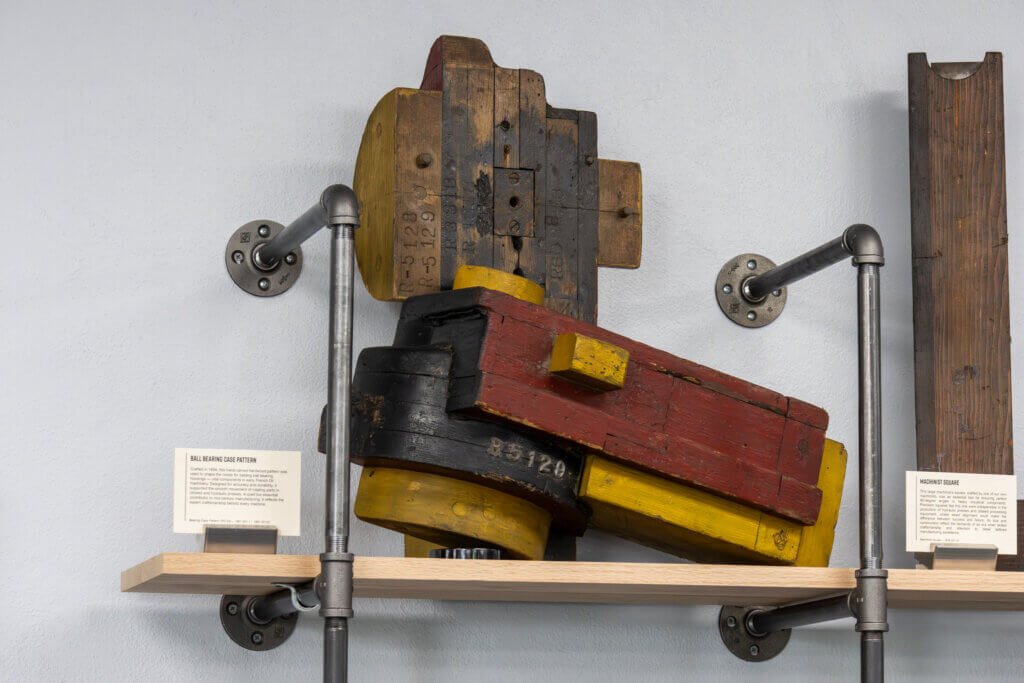
Ball Bearing Case Pattern
Crafted in 1954, this hand-carved hardwood pattern was used to shape the molds for casting ball bearing housings — vital components in early French Oil machinery. Designed for accuracy and durability, it supported the smooth movement of rotating parts in oilseed and hydraulic presses. A quiet but essential contributor to mid-century manufacturing, it reflects the expert craftsmanship behind every machine.
Bearing Case Pattern (R5129) – 1961.001.1 | 1961.00102
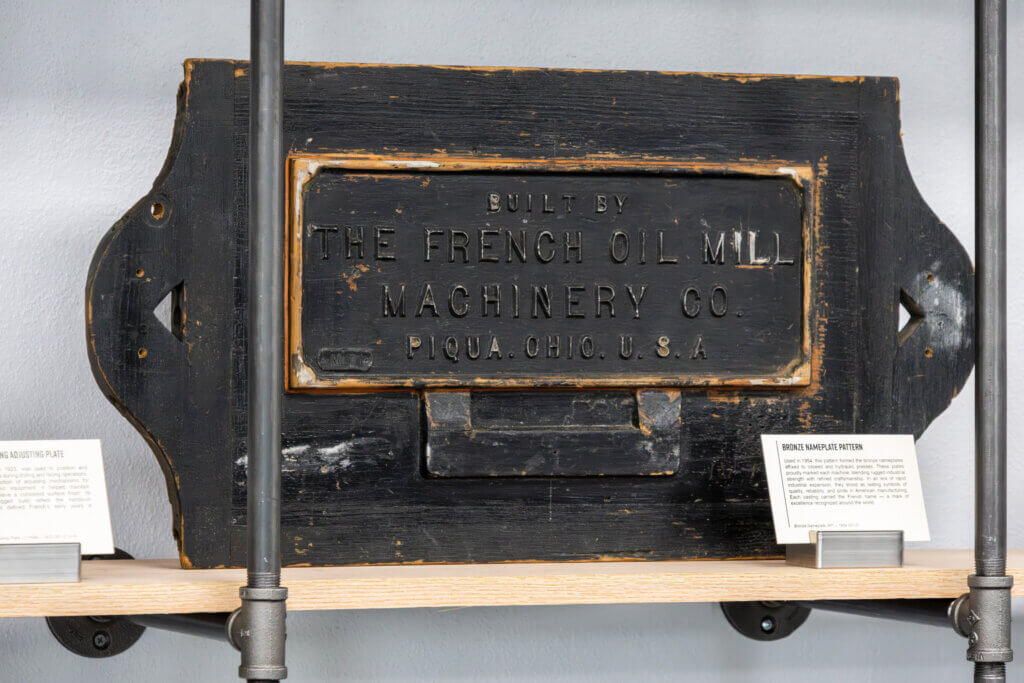
Bronze Nameplate pattern
Used in 1954, this pattern formed the bronze nameplates affixed to oilseed and hydraulic presses. These plates proudly marked each machine, blending rugged industrial strength with refined craftsmanship. In an era of rapid industrial expansion, they stood as lasting symbols of quality, reliability, and pride in American manufacturing. Each casting carried the French name — a mark of excellence recognized around the world.
Bronze Nameplate (M7) – 1954.001.01
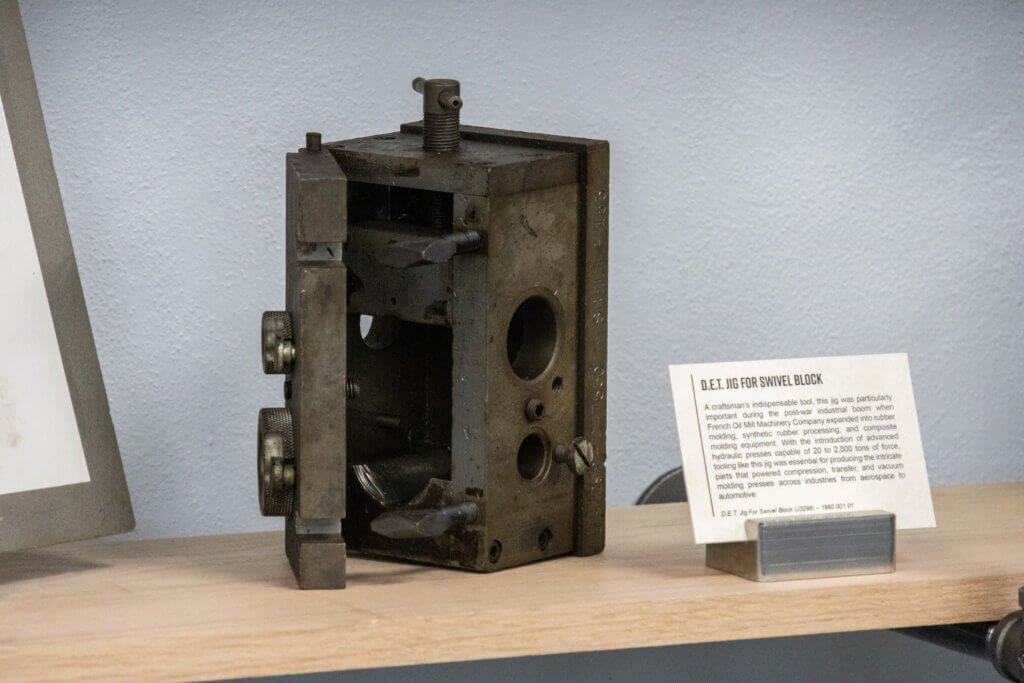
D.E.T. Jig for Swivel Block
A craftsman’s indispensable tool, this jig was particularly important during the post-war industrial boom when French Oil Mill Machinery Company expanded into rubber molding, synthetic rubber processing, and composite molding equipment. With the introduction of advanced hydraulic presses capable of 20 to 2,000 tons of force, tooling like this jig was essential for producing the intricate parts that powered compression, transfer, and vacuum molding presses across industries from aerospace to automotive.
D.E.T. Jig For Swivel Block (J3298) – 1960.001.01
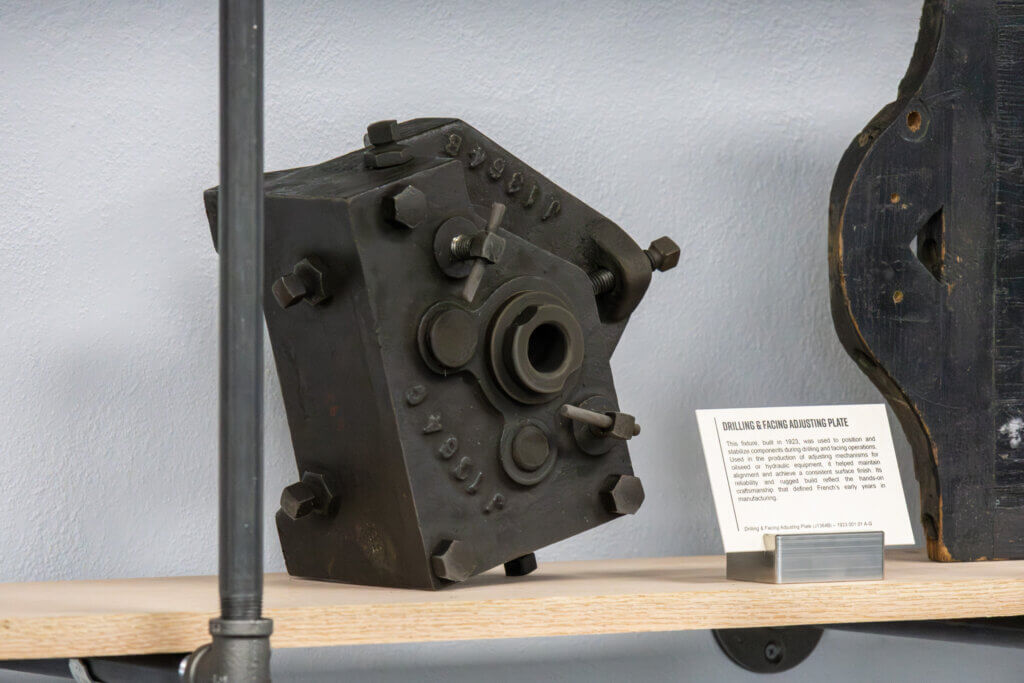
Drilling & Facing Adjusting plate
This fixture, built in 1923, was used to position and stabilize components during drilling and facing operations. Used in the production of adjusting mechanisms for oilseed or hydraulic equipment, it helped maintain alignment and achieve a consistent surface finish. Its reliability and rugged build reflect the hands-on craftsmanship that defined French’s early years in manufacturing.
Drilling & Facing Adjusting Plate (J1364B) – 1923.001.01 A-G
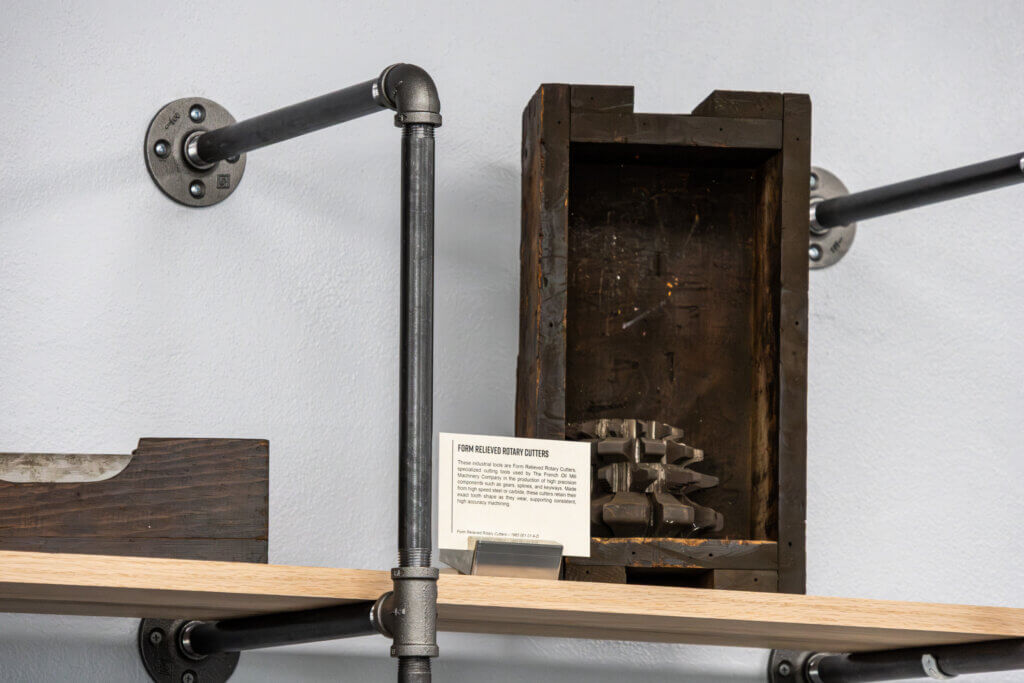
Form Relieved Rotary Cutters
These industrial tools are Form Relieved Rotary Cutters, specialized cutting tools used by The French Oil Mill Machinery Company in the production of high precision components such as gears, splines, and keyways. Made from high speed steel or carbide, these cutters retain their exact tooth shape as they wear, supporting consistent, high accuracy machining.
Form Relieved Rotary Cutters – 1965.001.01 A-D
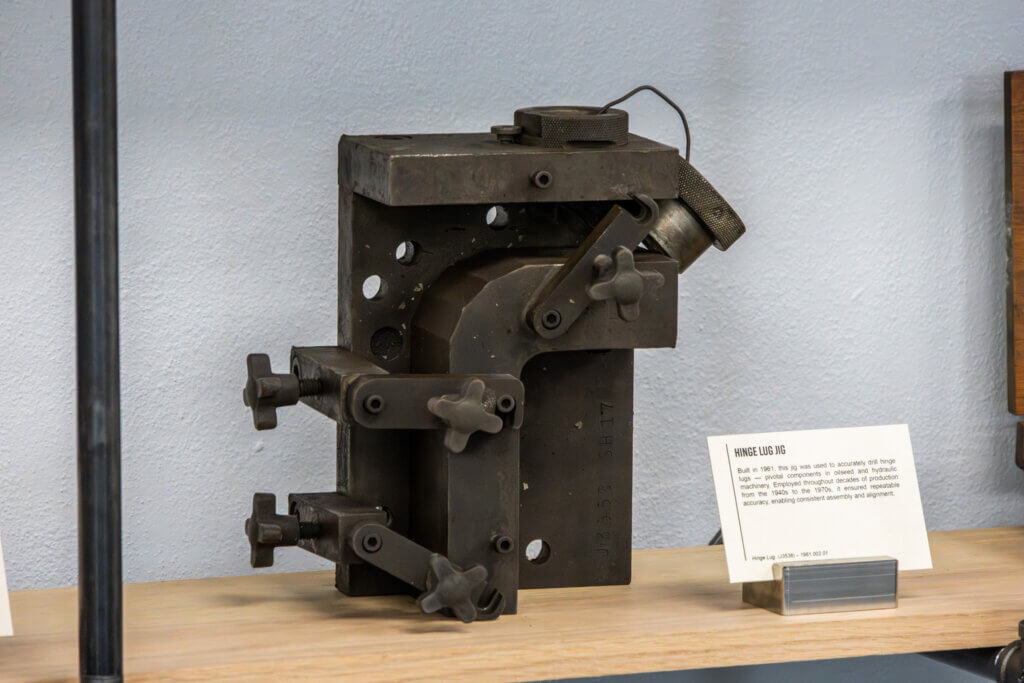
Hinge Lug Jig
Built in 1961, this jig was used to accurately drill hinge lugs — pivotal components in oilseed and hydraulic machinery. Employed throughout decades of production from the 1940s to the 1970s, it ensured repeatable accuracy, enabling consistent assembly and alignment.
Hinge Lug (J3538) – 1961.002.01
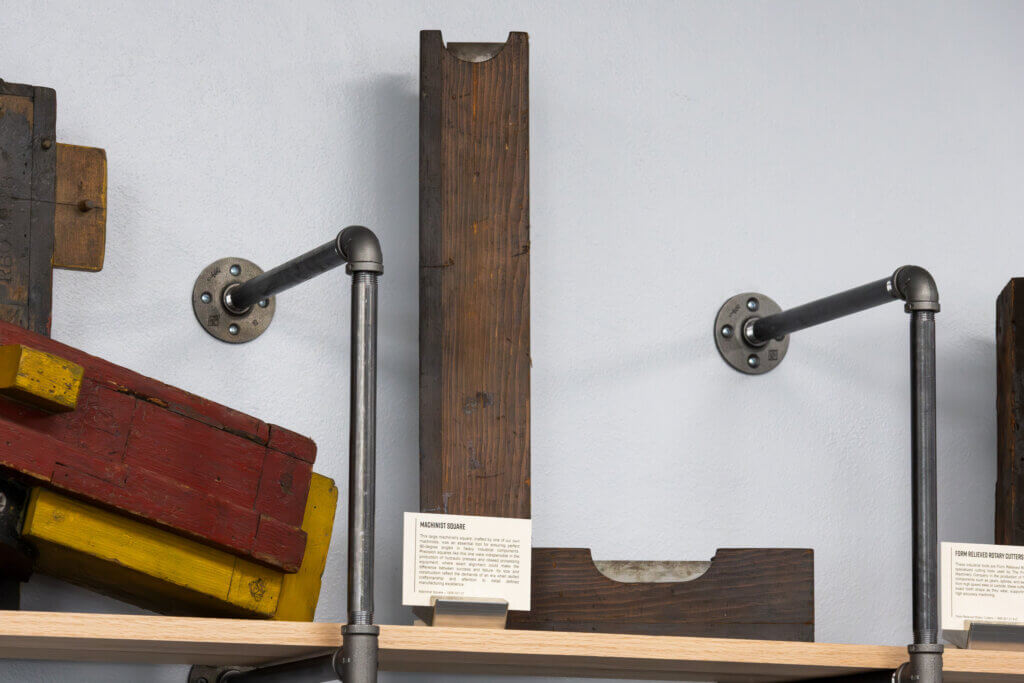
Machinist Square
This large machinist’s square, crafted by one of our own machinists, was an essential tool for ensuring perfect 90-degree angles in heavy industrial components. Precision squares like this one were indispensible in the production of hydraulic presses and oilseed processing equipment, where exact alignment could make the difference between success and failure. Its size and construction reflect the demands of an era when skilled craftsmanship and attention to detail defined manufacturing excellence.
Machinist Square – 1938.001.01
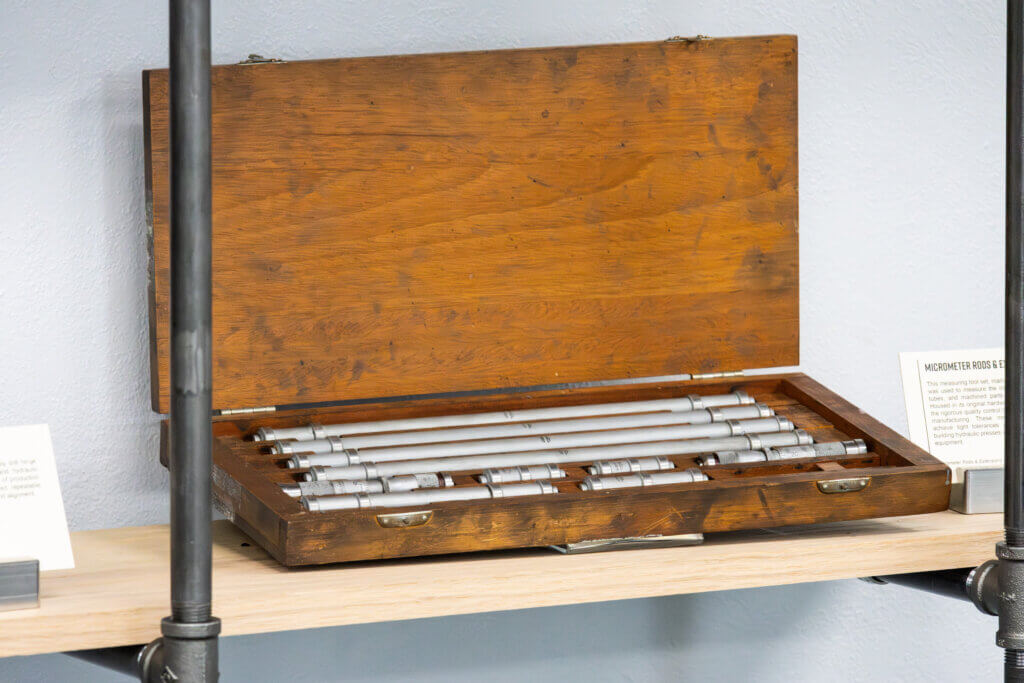
Micrometer Rods & Extensions
This measuring tool set, manufactured by Lufkin in 1963, was used to measure the internal dimensions of bores, tubes, and machined parts with exceptional accuracy. Housed in its original hardwood case, the set represents the rigorous quality control that defined mid 20th century manufacturing. These measuring extensions helped achieve tight tolerances and exact fits, essential for building hydraulic presses and other demanding industrial equipment.
Micrometer Rods & Extensions – 1963.001.01
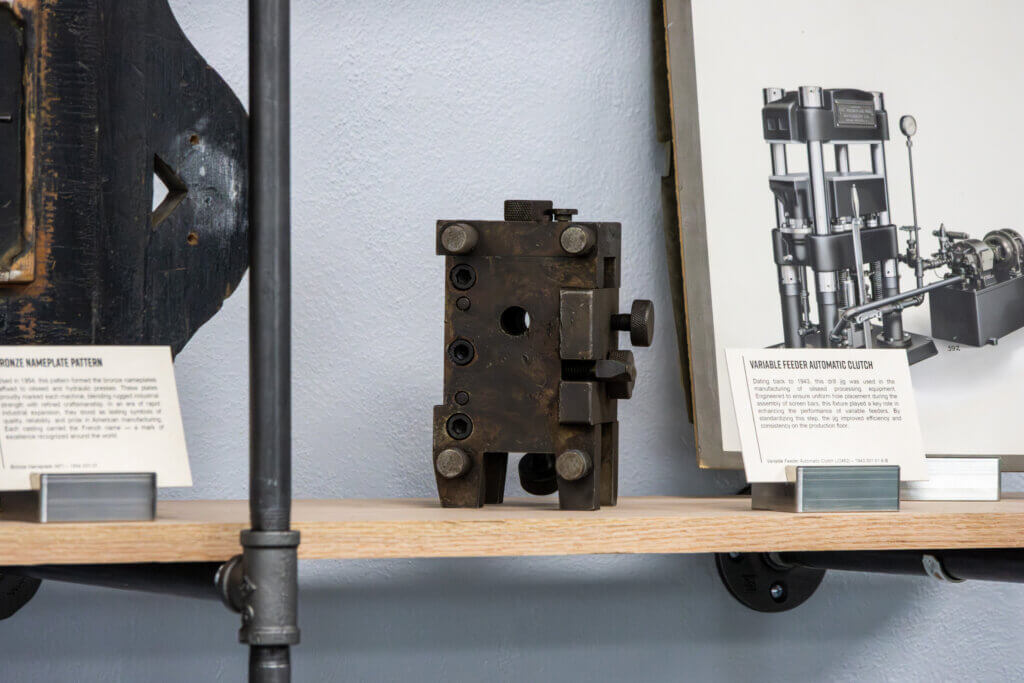
Variable Feeder Automatic Clutch
Dating back to 1943, this drill jig was used in the manufacturing of oilseed processing equipment. Engineered to ensure uniform hole placement during the assembly of screen bars, this fixture played a key role in enhancing the performance of variable feeders. By standardizing this step, the jig improved efficiency and consistency on the production floor.
Variable Feeder Automatic Clutch (J2482) – 1943.001.01 A-B