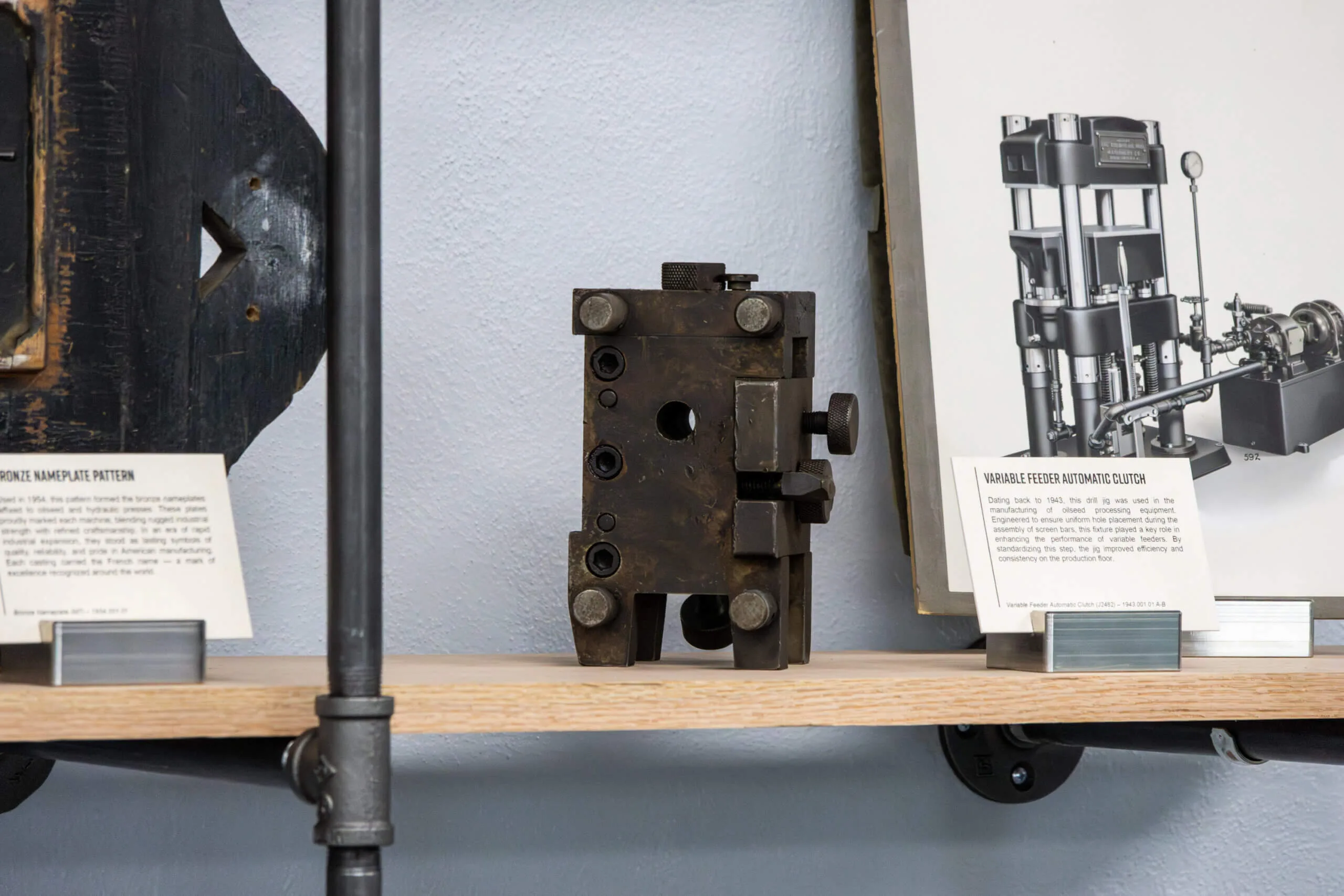
A History of Excellence, Innovation, and Legacy
The French Museum preserves the working record of The French Oil Mill Machinery Company: original patents, hand-carved foundry patterns, machinists' tools, and the artifacts of 125 years of American manufacturing. The company was founded in 1900 by Alfred Willard French Sr. in Piqua, Ohio, and it has been building hydraulic presses and oilseed processing equipment ever since. The collection is housed at the company's Piqua headquarters and is not open to the public.
Steel remembers. Every object in this collection carries the mark of the hands that made it and the era that demanded it. Across five family leaders and four generations, French machinery has powered the oilseed, rubber, plastics, composite, and laminate industries. It runs today in more than 80 countries.
More than machines, we build solutions, and with them a responsibility: to our dedicated employees, our loyal customers, our shareholders, our communities, and our country. With each innovation, each challenge overcome, and each solution delivered, we reaffirm our purpose: We make machines to make people's lives better.
Our history is written in steel, precision, and perseverance. What follows is the evidence.
Respecting our Past – Challenging the Future.
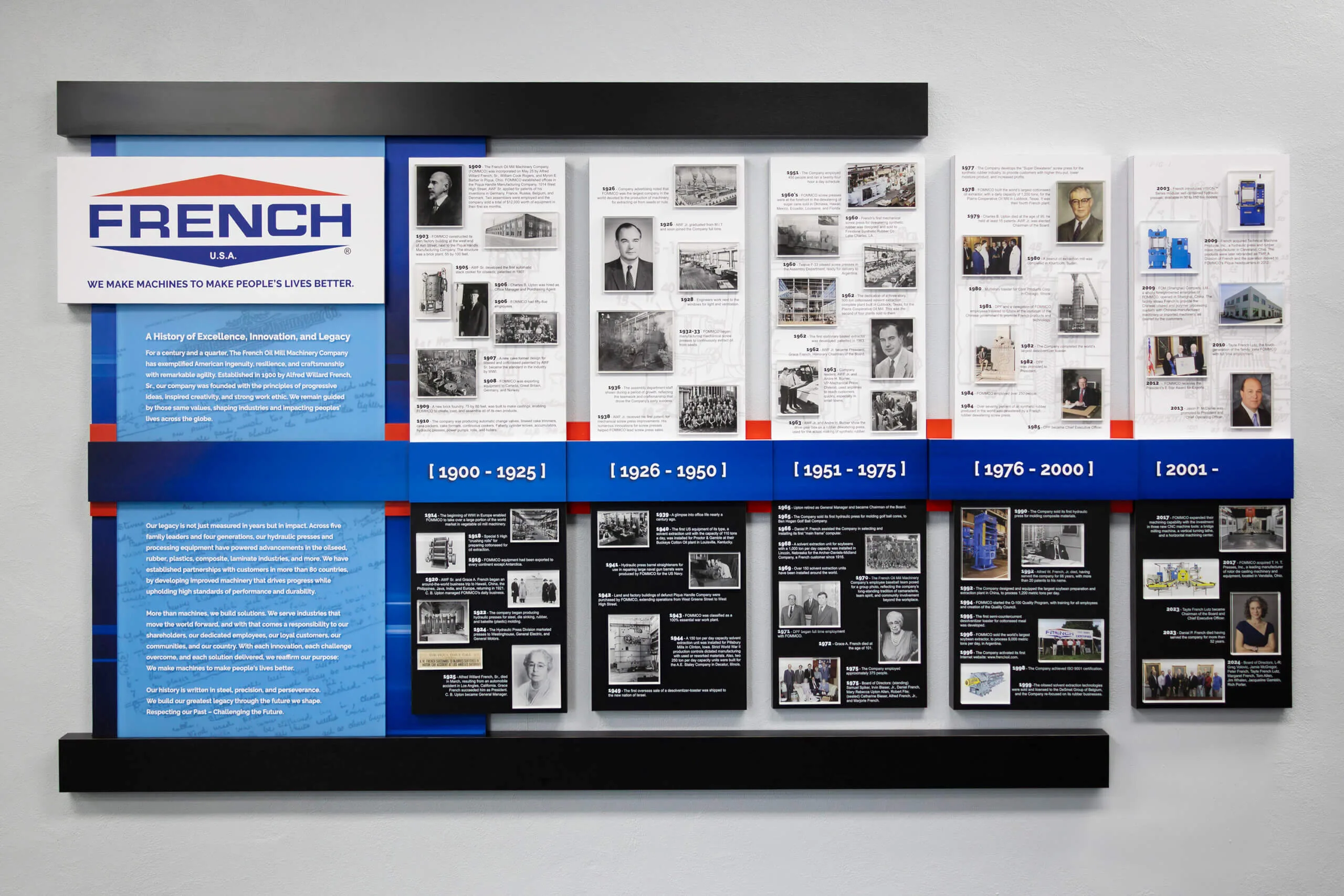
The 1903 Reissue Patent: A Machine for Trimming Oil-Cakes
U.S. Reissue Patent No. 12,118 was granted on June 9, 1903 to Alfred W. French Sr. of Piqua, Ohio, for a Machine for Trimming Oil-Cakes. Reissue patents ran in their own numbering series, which is why the document bears a low number for its year. Its header tells the company's whole early story. The original patent, No. 655,337, was dated August 7, 1900, when The French Oil Mill Machinery Company was not yet three months old, and it built on a trimmer the founder had patented in April 1899, before the company existed. The machine did the unglamorous work that makes pressing pay: oil cakes leave a press hard in the body and soft at the rim, and this machine trimmed the soft margins from each cake, kept the finished cakes piling at a constant level, and moved them off for transport. Trimmers came before presses at French. This document is why.
AWF Sr. Reissue Patent (RE 12,118) – 1903.001.01
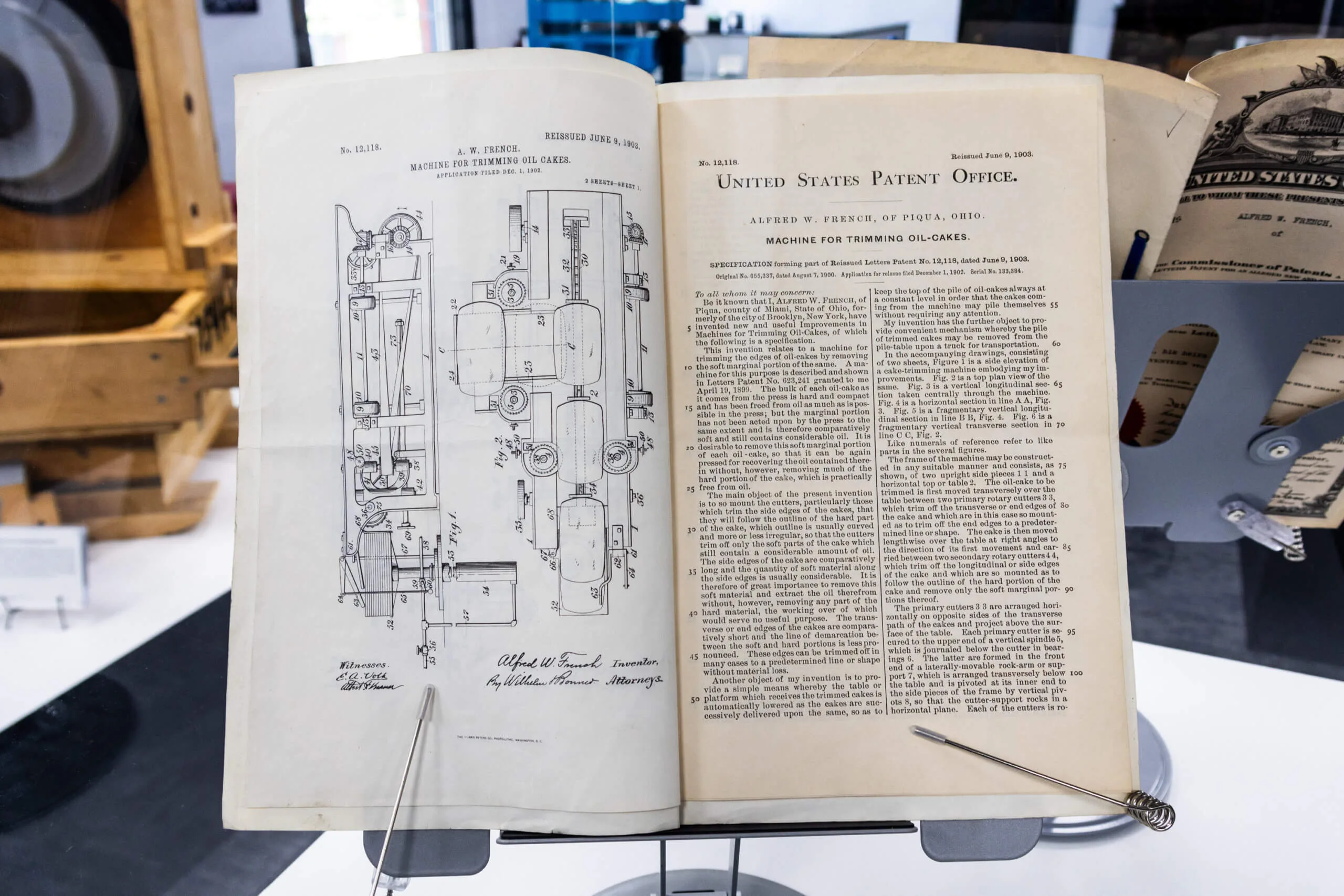

The 1927 Patent That Outlived Its Inventor
U.S. Patent No. 1,648,477 for an Expressing Apparatus was granted on November 8, 1927 to Alfred W. French of Piqua, Ohio. Read the dates on the document and the story opens. The application was filed on September 12, 1921, the year linseed prices collapsed and nearly took the company with them; the founder answered the crisis by improving the machine at the center of it. His invention refined cage-type expressing presses, in which material is loaded in layers separated by press plates and cloths and squeezed in an open-ended upright cage. The problem was clogging: under pressure, meal squeezed into the cage's drainage openings and slowed the oil's escape, especially with oil-rich materials like copra. His answer was a porous drainage mat between the meal and the cage wall, letting the oil pass freely while holding the meal back. Alfred W. French Sr. died in March 1925. The Patent Office granted his application two and a half years later, into a company then led by his widow, Grace. The work outlived the man.
Expressing Apparatus Patent - 1927.001.01
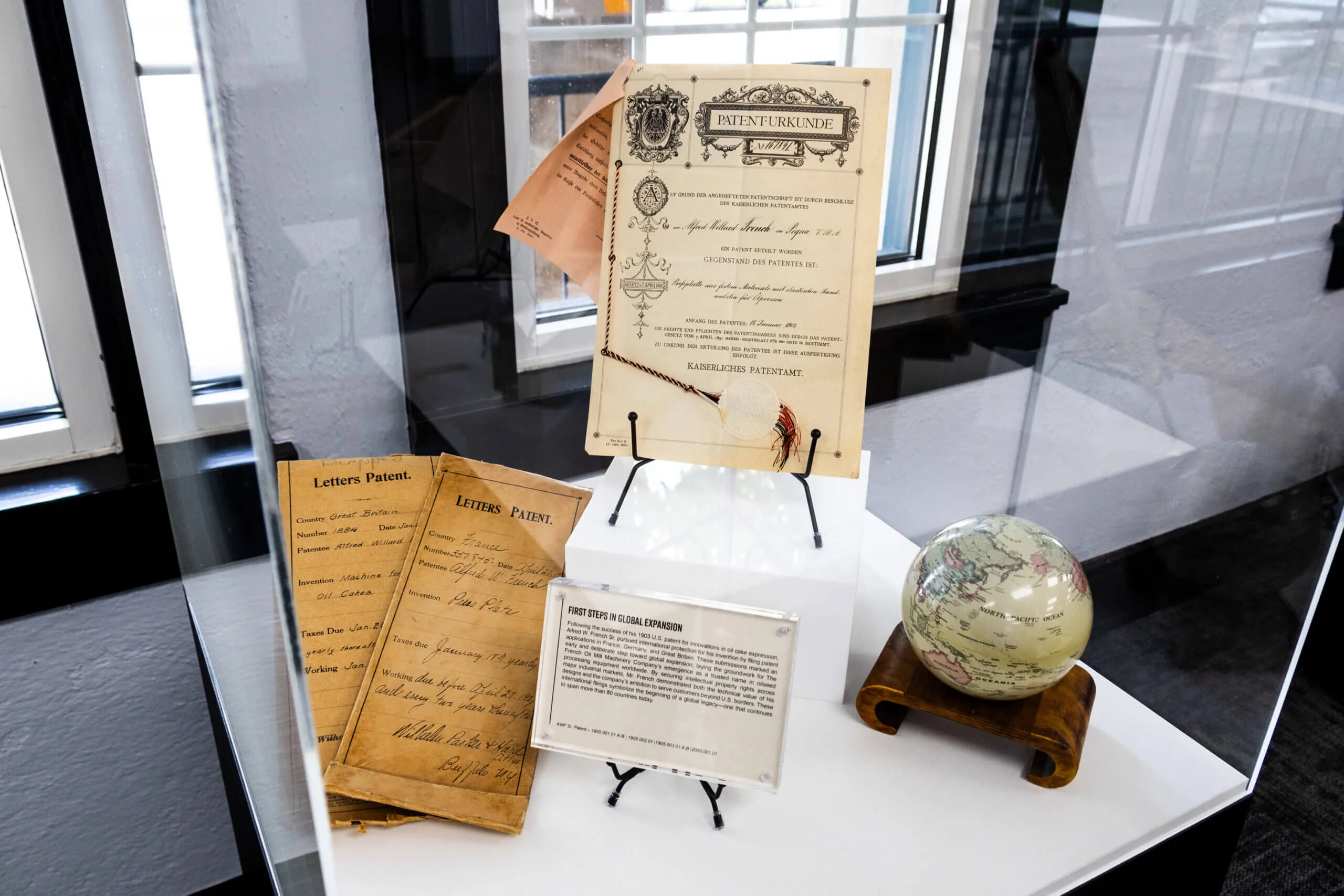
First Steps in Global Expansion: The International Patents
Alfred W. French Sr. filed for patent protection on his oil press improvements in France, Germany, and Great Britain within a few years of the 1903 U.S. grant. The company was barely five years old and already treating the world as its market. The paperwork came first; the machines followed. The French Oil Mill Machinery Company shipped its first export orders in 1908, to Canada, Great Britain, Germany, and Norway, and by 1919 its machinery was running on every continent except Antarctica. The documents displayed here mark where that reach began. Today French equipment operates in more than 80 countries.
AWF Sr. International Patents – 1905.001.01 A-B | 1905.002.01 | 1905.003.01 A-B | 2000.001.01
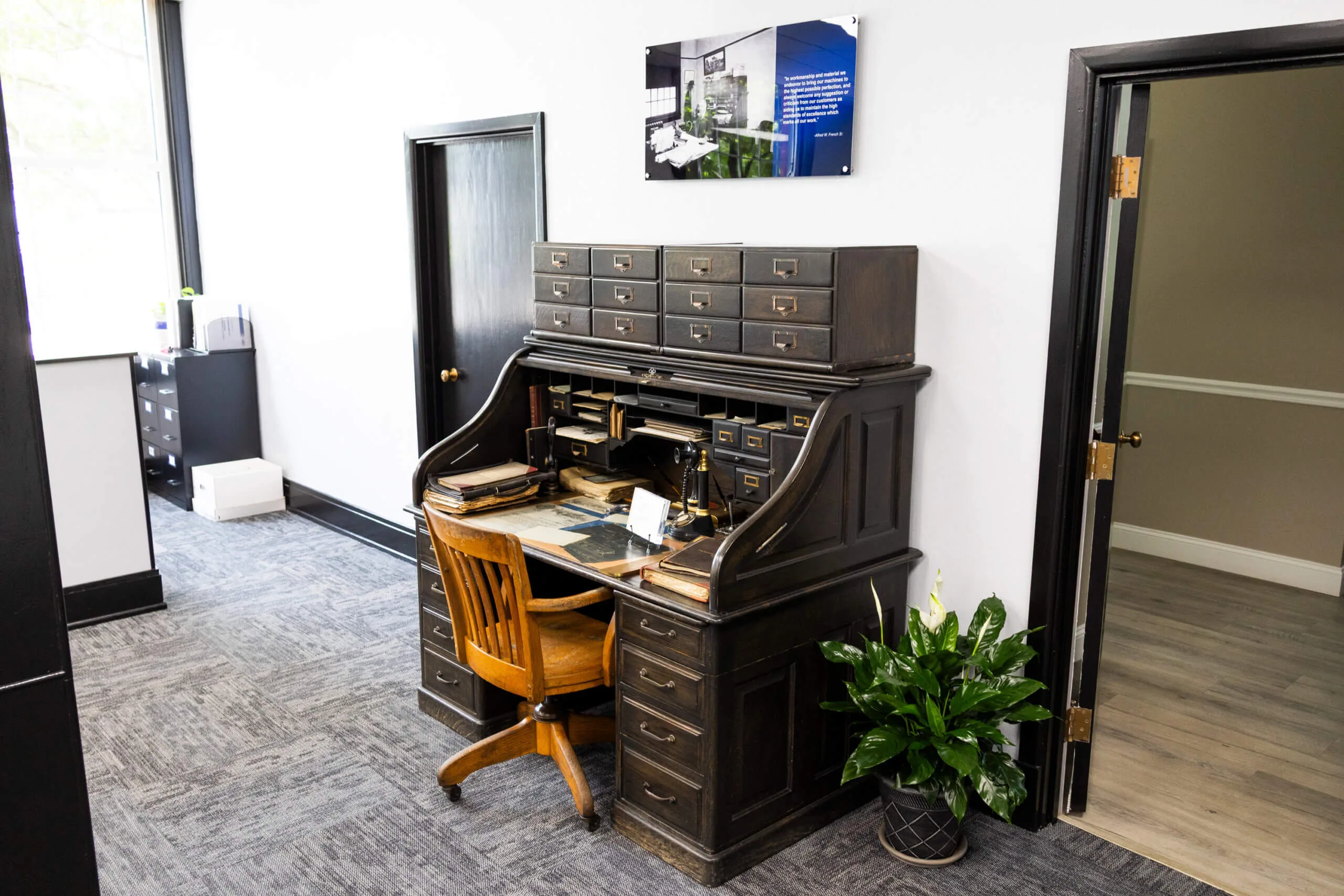
The Founder's Desk
This roll top desk belonged to Alfred Willard French Sr., the engineer who founded The French Oil Mill Machinery Company in 1900 and led it until his death in 1925. At this desk our founder worked out the ideas that became patents, among them a linseed cake trimmer and an automatic hydraulic valve, both of which became standards in oilseed processing. The surface is arranged with the instruments of a working day in the company's first years: ledgers tracking early sales, contracts and international documents, handwritten letters, a telephone, a slide rule, a desk calendar. The story starts before the desk. In 1897 he made a visit to troubleshoot a machine. He stayed to build a company, and the rest of this museum followed.
AWF Sr. Roll Top Desk – 1910.001.01
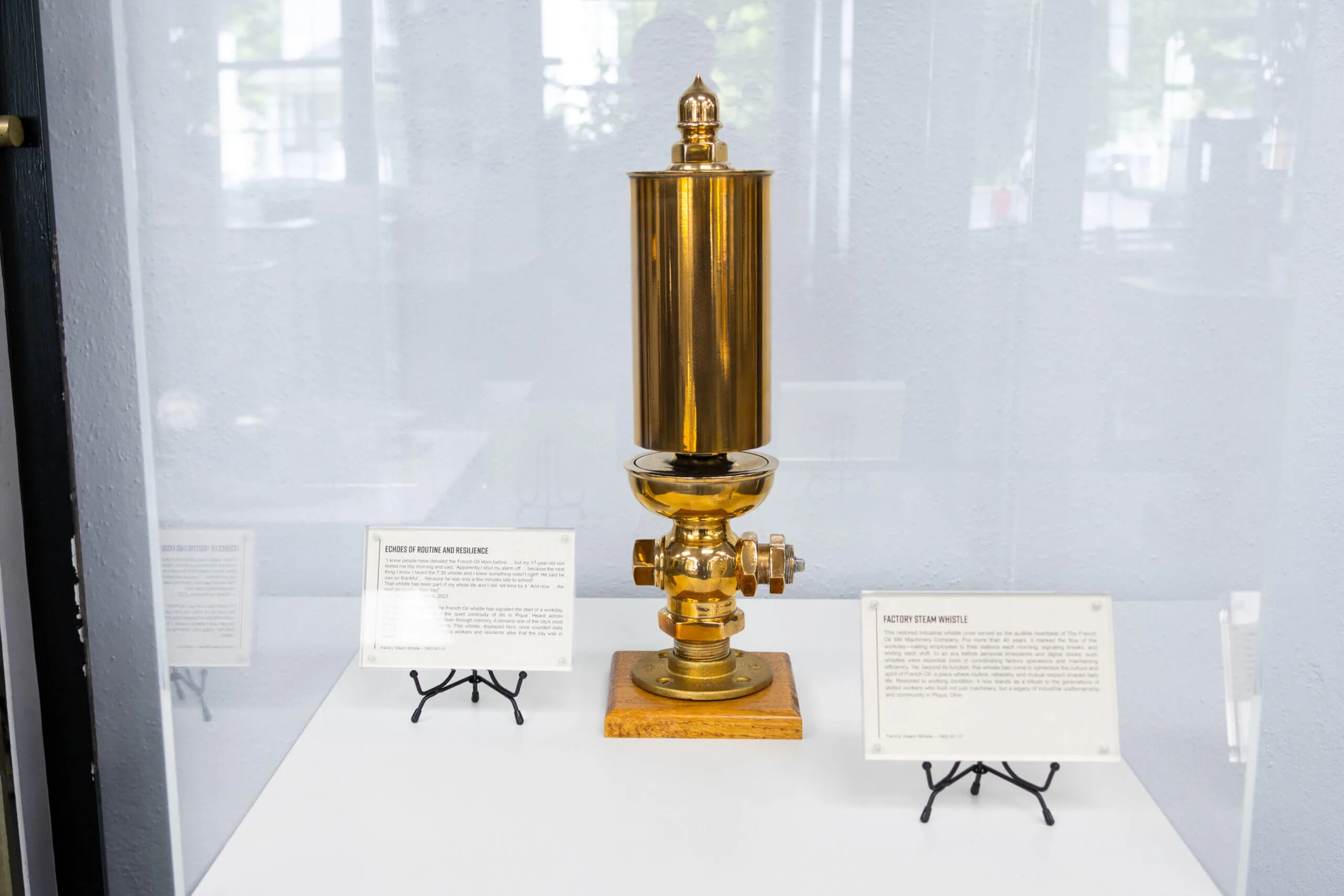
The Factory Steam Whistle: The Sound Piqua Tells Time By
This restored steam whistle sounded from the factory roof of The French Oil Mill Machinery Company for more than 40 years, calling employees to their stations each morning, marking breaks, and ending every shift. Factory whistles ran the working day in towns like Piqua, and this one ran more than the factory: the neighborhoods around it heard it too, and set their clocks by it. The whistle displayed here has been restored to working condition, and the sound carries on. Piqua still tells time by the 7:30 signal. One resident put it this way in 2023:
"I know people have debated the French Oil Horn before … but my 17-year-old son texted me this morning and said, 'Apparently I shut my alarm off … because the next thing I know I heard the 7:30 whistle and I knew something wasn't right!' He said he was so thankful … because he was only a few minutes late to school! That whistle has been part of my whole life and I still 'tell time by it.' And now … the next generation does too!" — Shared on Facebook, 2023
Generations of skilled workers answered that sound. What they built fills this room.
Factory Steam Whistle – 1900.001.01
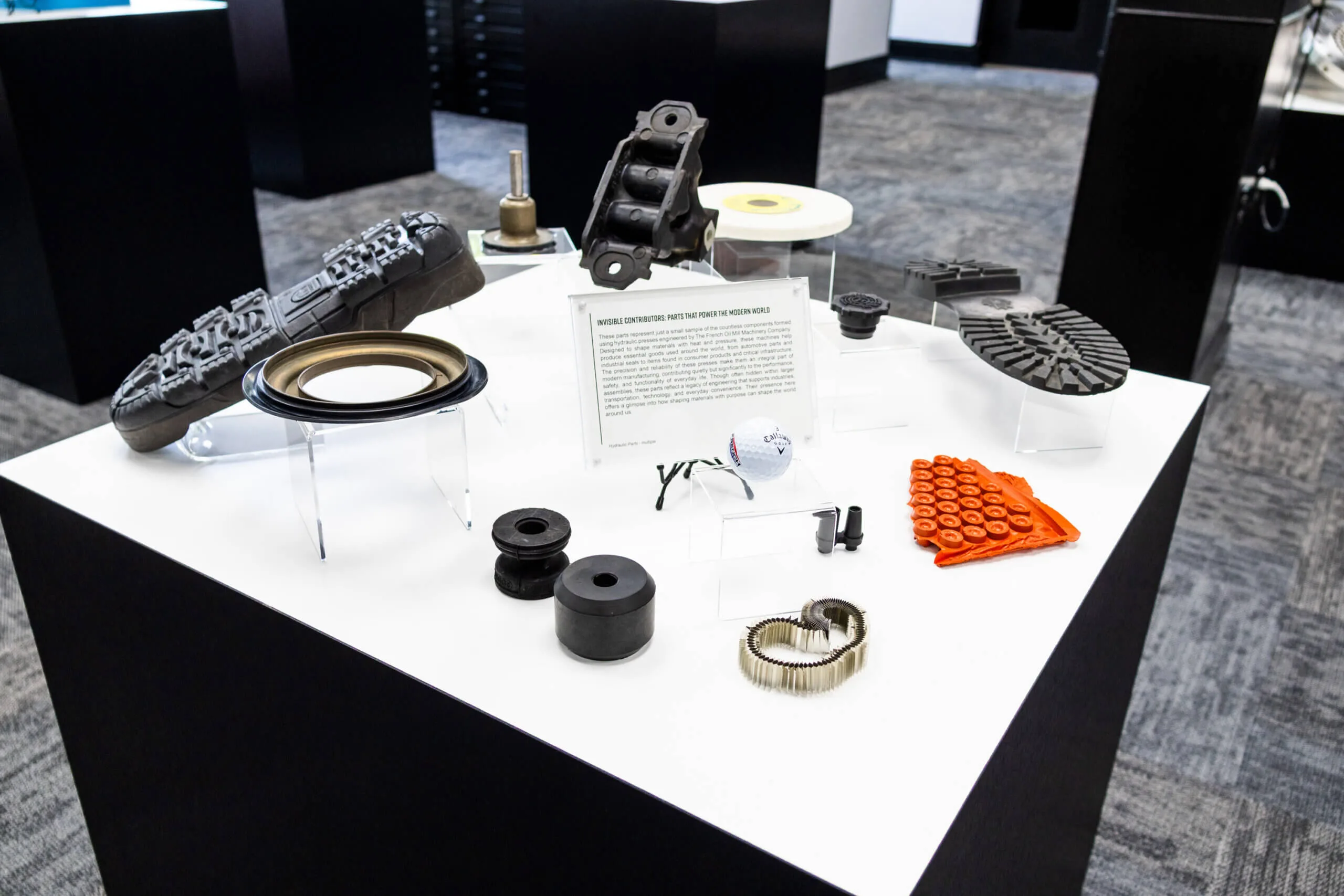
Invisible Contributors: Parts That Power the Modern World
The parts in this case were formed on hydraulic presses engineered by The French Oil Mill Machinery Company, a small sample of what its machines produce every day. A French press shapes material with heat and pressure: rubber into seals and gaskets, composites into automotive and aircraft components, abrasives into grinding wheels, laminates into circuit boards. Most of it is never seen. It rides inside a car door, an aircraft, a medical device, a piece of infrastructure, doing its work out of sight. That is the point of this display: to make the invisible visible for a moment. The presses that formed these parts are working right now.
Hydraulic Parts – 2026.001.01
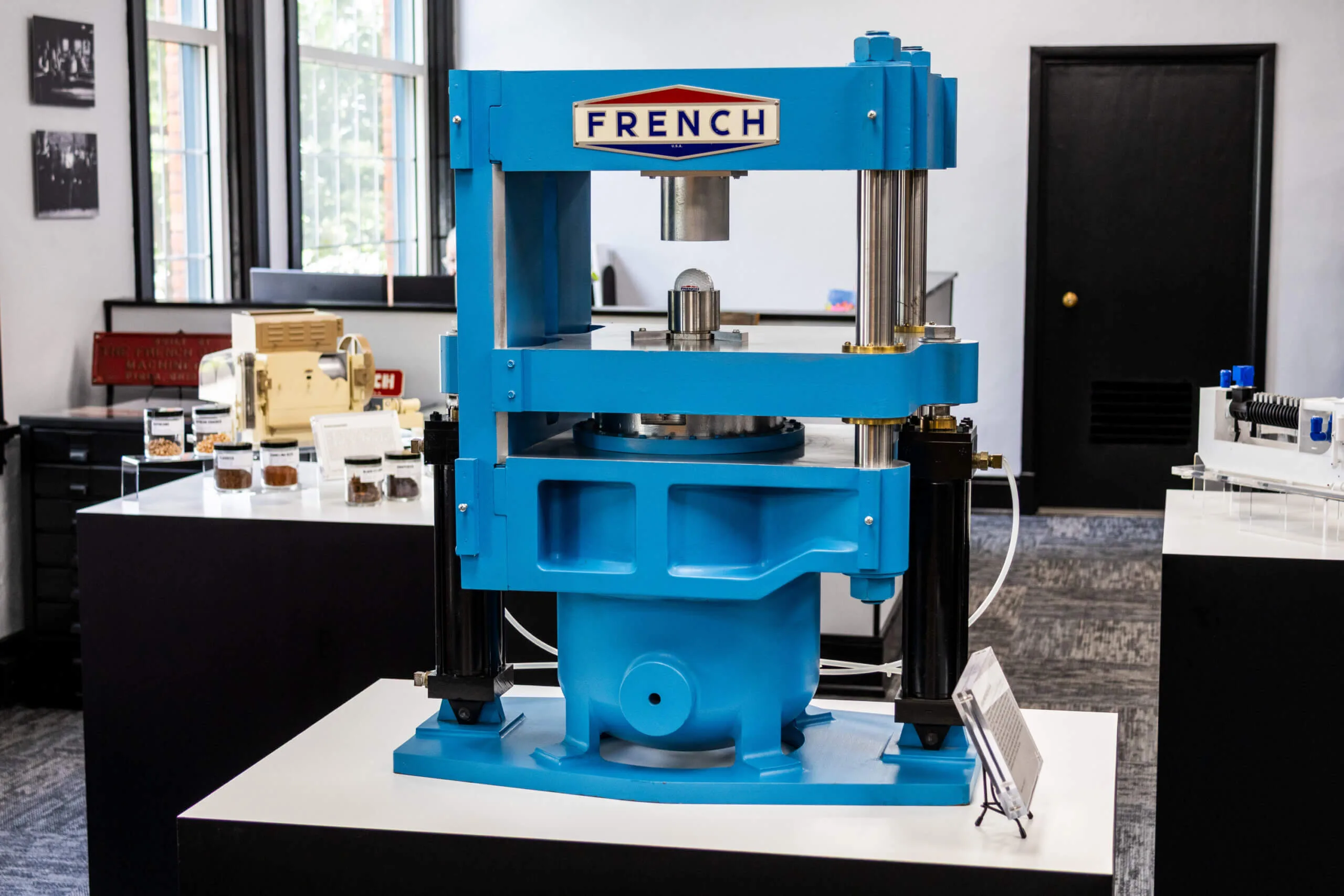
Hydraulic Press for Golf Ball Molding
This scale model shows an up-acting hydraulic press of the type The French Oil Mill Machinery Company builds for molding golf balls, in this case for Callaway. The model is split deliberately: the left half is built with sideplate construction, the right half with the four-post column option, so one model shows both ways French engineers frame a press. The open-front C design gives operators clear access for loading and unloading molds, which matters in work where parts are handled constantly. In production, the press molds golf ball components under tightly controlled pressure and temperature, and the up-acting platen delivers the smooth, even force that forms the ball's durable outer layers. In sporting goods, consistency is the product: every ball has to behave like the last one. This is the machine that answers for that.
Hydraulic Press Model – 1983.001.01
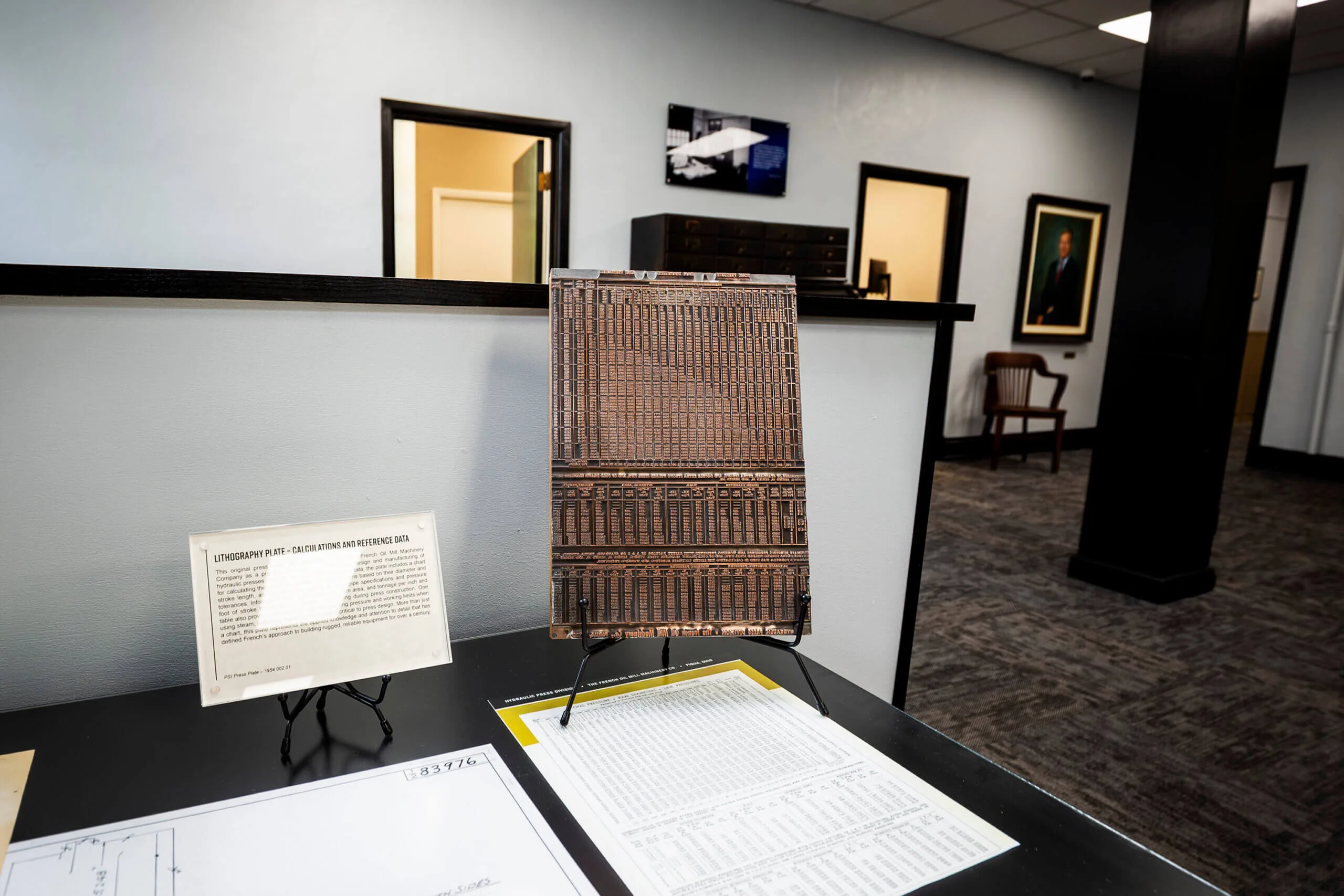
The Lithography Plate: Printing the Engineer's Numbers
This etched plate carries the working arithmetic of hydraulic press engineering at The French Oil Mill Machinery Company. Its tables give the pressure a hydraulic ram exerts by diameter and stroke, tonnage per inch and per foot of stroke, line pressure, ram area, steel pipe specifications, and pressure tolerances. One table states ultimate bursting pressures and working limits for steam, because a press is an exercise in enormous force under control, and the margin between working pressure and bursting pressure is where the engineering lives. The plate itself is lithographic: its text runs in reverse, because its job was to print the reference sheets that engineers kept at their desks and drawing boards. Before software carried these numbers, metal did. French engineers built rugged, reliable presses to the figures this plate printed, and the figures held.
PSI Press Plate – 1954.002.01
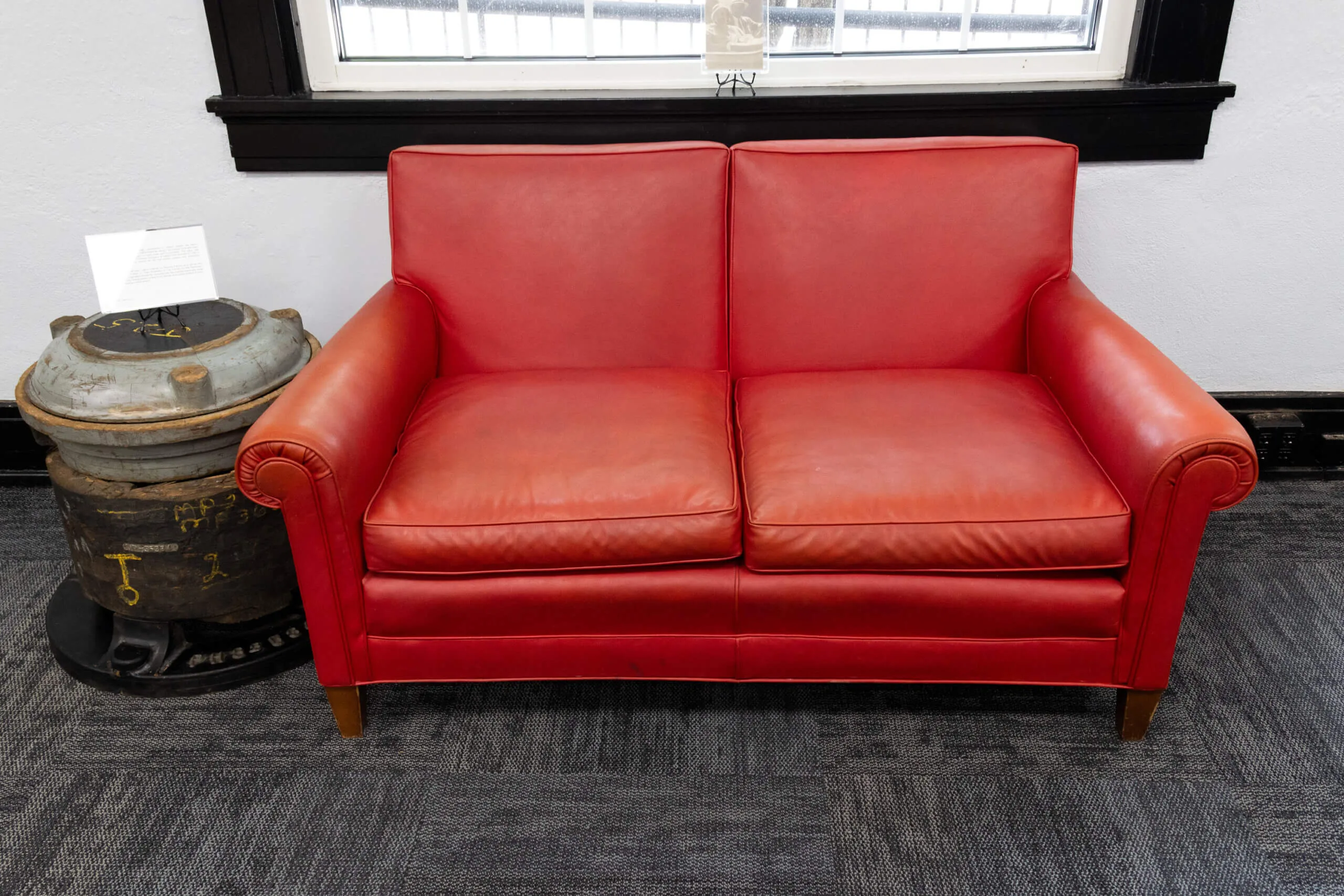
The Lipstick Red Loveseat
Most of what this museum preserves is steel. This is the exception. This loveseat, made in 1960, was custom-ordered by Marjorie French as a gift for her husband, Alfred W. French Jr., two years before he became President of The French Oil Mill Machinery Company. It came from the Shaw Furniture Company of Cambridge, Massachusetts, a firm that traced its founding to 1780, and the label under the frame reads "1960 Lipstick Red": the color's name is the maker's own. It wears its era openly, compact form, clean lines, and a red that has not quieted down since. The gift was meant for their home. It migrated to headquarters instead, the way things do in a family company, and it stayed. It has been brightening a machine works ever since.
Loveseat – 1960.001.02
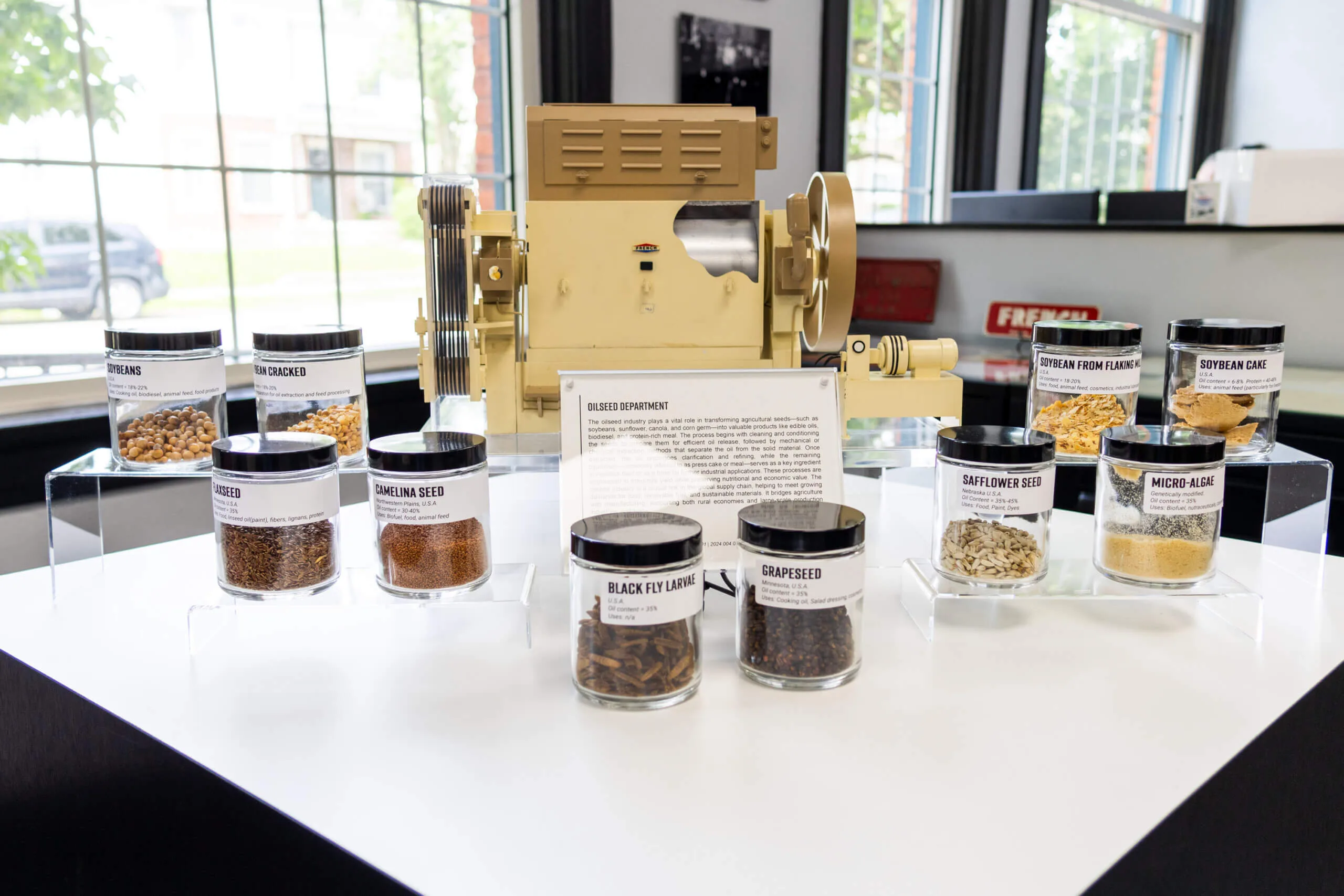
The Oilseed Department: From Seed to Oil
This display follows the work The French Oil Mill Machinery Company has equipped since 1900: turning agricultural seeds into oil. Oilseed processing converts soybeans, sunflower, canola, and corn germ into edible oils, biodiesel, and protein-rich meal. The sequence has held steady across a century of changing technology. Seeds are cleaned and conditioned for efficient oil release; mechanical pressing or extraction separates the oil from the solids; the crude oil is clarified and refined. Nothing is wasted: the pressed solids, called press cake or meal, go on to feed livestock and supply industrial uses. The industry bridges agriculture and manufacturing, and the world's demand for food, renewable fuel, and protein keeps it growing. French equipment has worked inside this sequence from the company's first patent onward. The samples here show the process at its stages, side by side.
Oilseed Materials – 2026.002.01
The Polymer Department: From Seed Oil to Synthetic Rubber
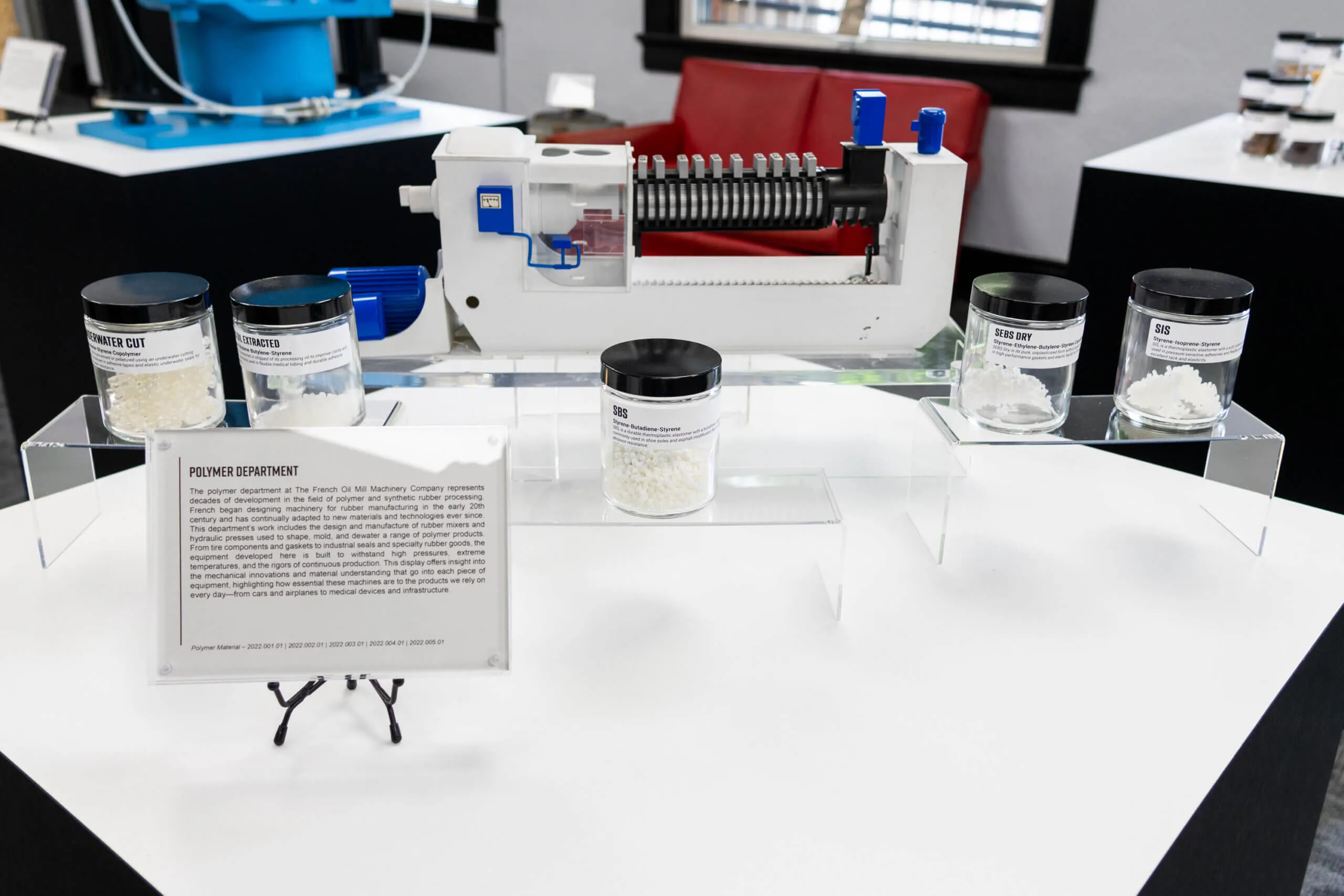
The polymer department at The French Oil Mill Machinery Company engineers dewatering screw press systems and mechanical dryers for synthetic rubber and thermoplastics. The department exists because of a transfer of skill. French's first machines served agriculture: trimmers, then hydraulic cake presses, then continuous screw presses that squeezed oil from seed. In 1960, Firestone asked whether a French screw press could squeeze the water out of synthetic rubber instead. Drawing on cage geometry and feed control refined on oilseed, French engineers built it, and dewatering became a business of its own: by 1984, seventy percent of the world's synthetic rubber was dewatered on French presses. Today French systems run from pilot machines for the laboratory to presses handling 12 metric tons an hour, for producers in more than 23 countries, on materials with names like ESBR, EPDM, SIS, and ABS. The engineering idea is the one French learned pressing oil from seed: keep the material moving, and press.
Polymer Materials – 2026.003.01
Heat, Flow, and Finish: Inside a Polymer Dewatering Press
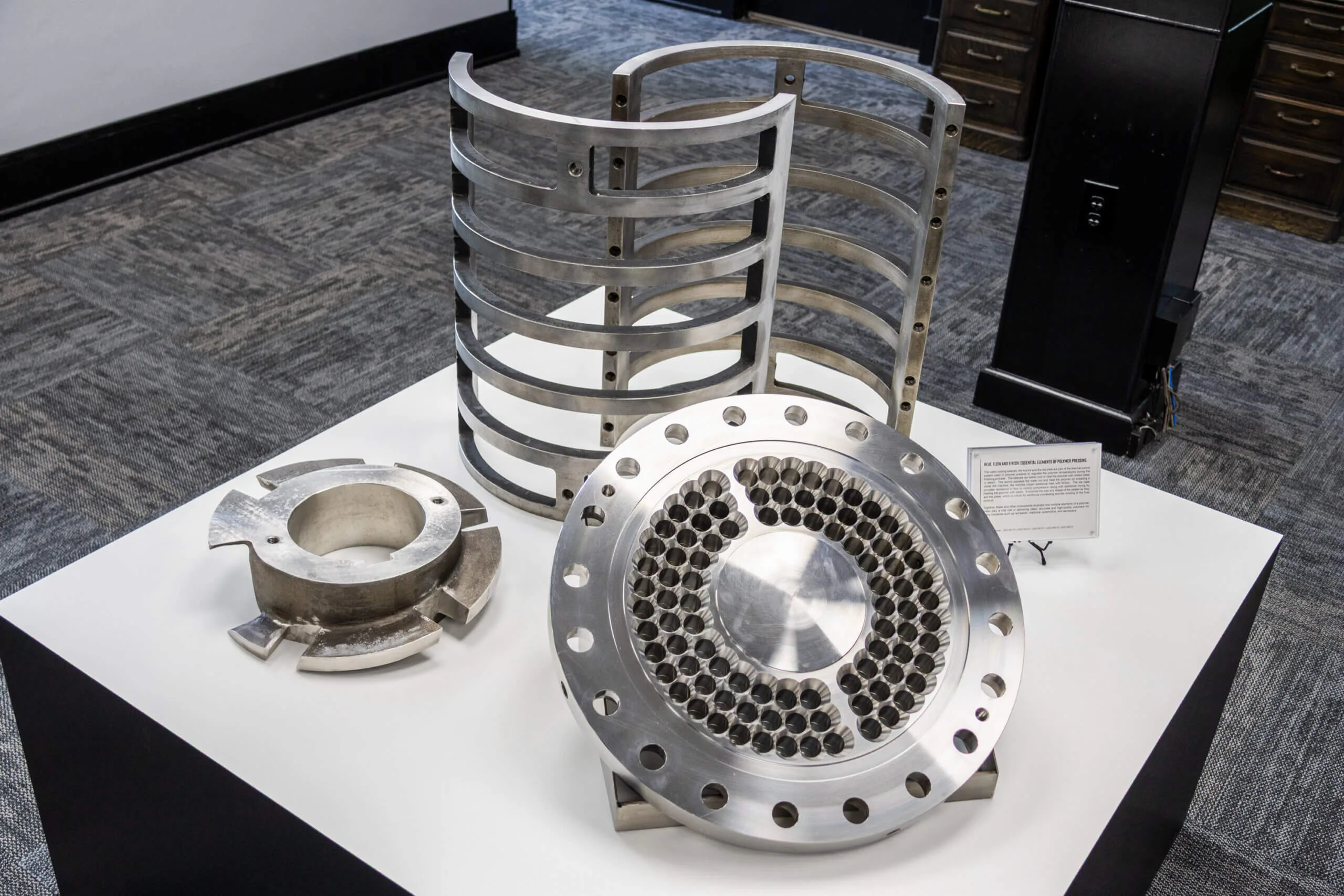
The components displayed here come from French dewatering and drying presses: water cooling sleeves, worms, and a die plate, the parts that manage heat and flow as polymer moves through the machine. Each has one job. The sleeves jacket the press and either cool or heat the polymer, with chilled water or steam. The worms do the squeezing, driving water out while kneading the material, their notches adding heat through friction. The die plate stands at the exit, resisting the flow to control compression, drying the polymer further with steam, and sizing the pellets as they leave, which determines how the material behaves in everything that happens to it next. Temperature, pressure, and flow, managed inch by inch through one machine. That is what clean, consistent polymer requires, in industries from medicine and aerospace to automotive and recreation.
Polymer Parts – 2022.006.01 A-B (Water Cooling Sleeves) | 2022.008.01 (Die Plate) | 2022.007.01 (Worms)
Behind the Press: The Discharge Worm Bearing Pattern
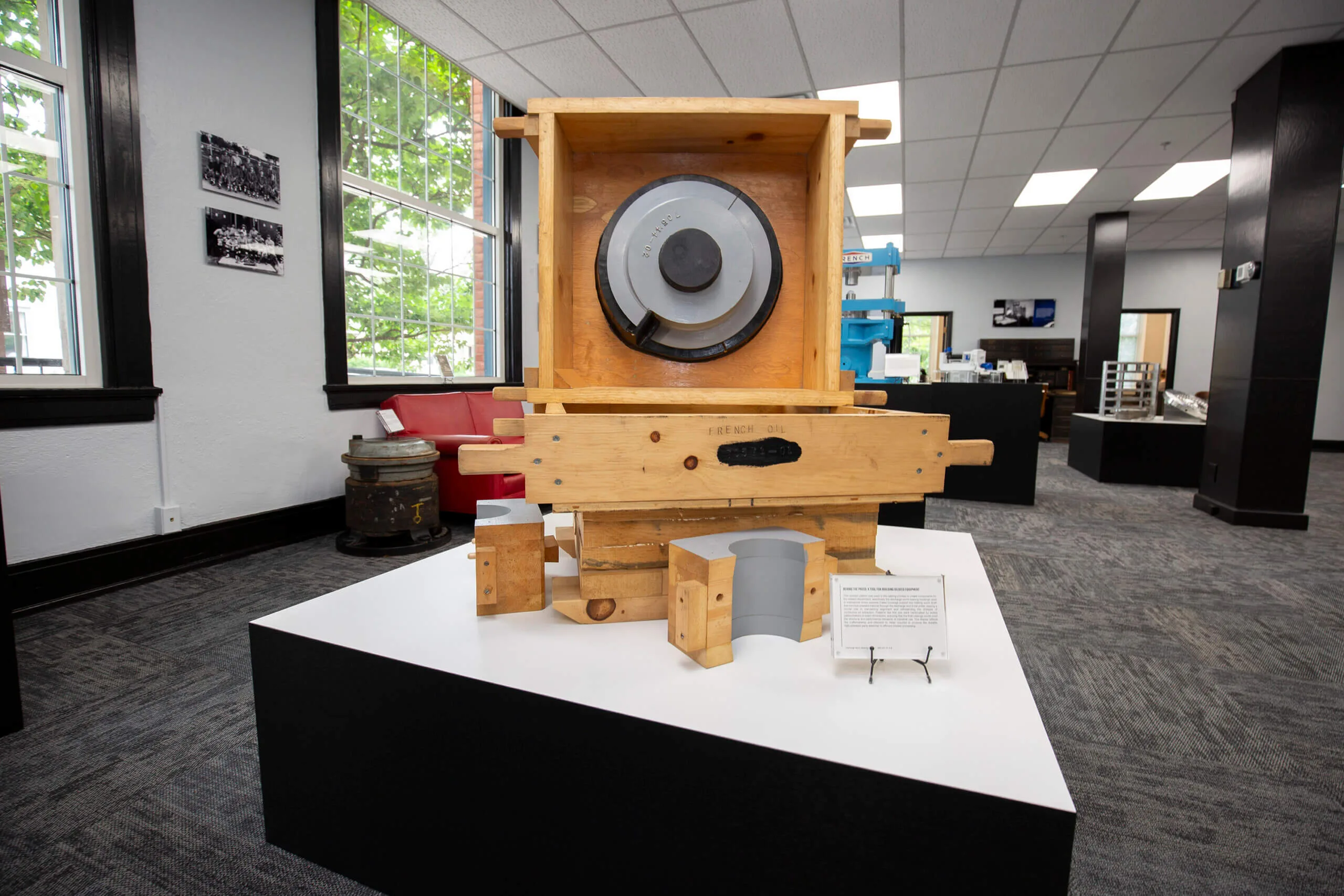
Before a part could be cast, it had to exist in wood. This hand-carved pattern made the discharge worm bearing housings for French mechanical screw presses: a patternmaker shaped it to exact dimensions, the foundry pressed it into molding sand, and molten metal filled the cavity it left behind. The housing it produced supports the rotating worm shaft that carries pressed material out the discharge end of the press, holding alignment against the stresses of continuous oil extraction. A pattern had to be more precise than the casting, because every error in the wood repeated in every part poured from it. Patternmaking was a skilled trade at French for generations; two of its practitioners, Frank and Philip Sullenberger, stand on the Roll of Honor elsewhere in this museum.
Discharge Worm Bearing Pattern – 1995.001.01 A-B
Roll of Honor
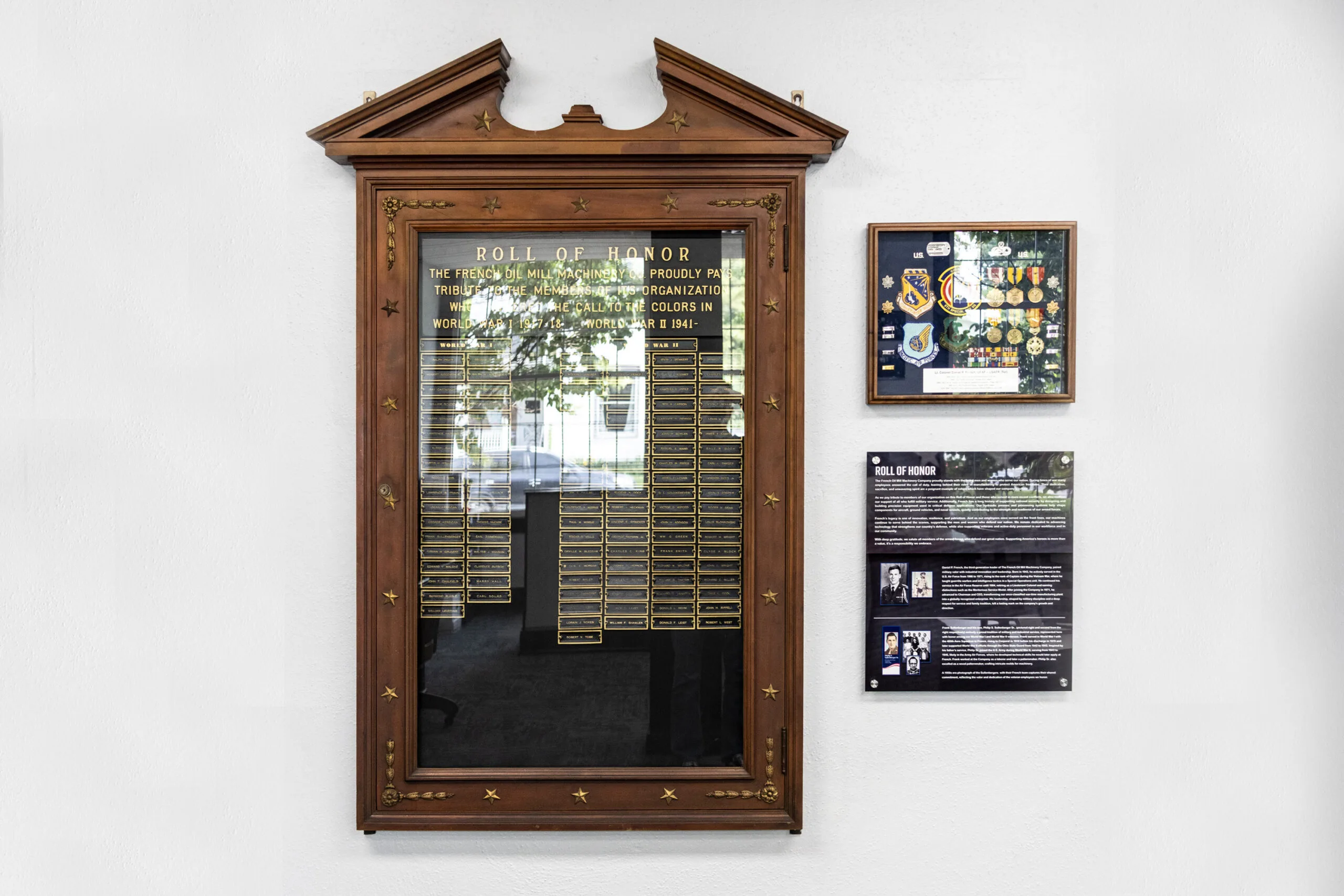
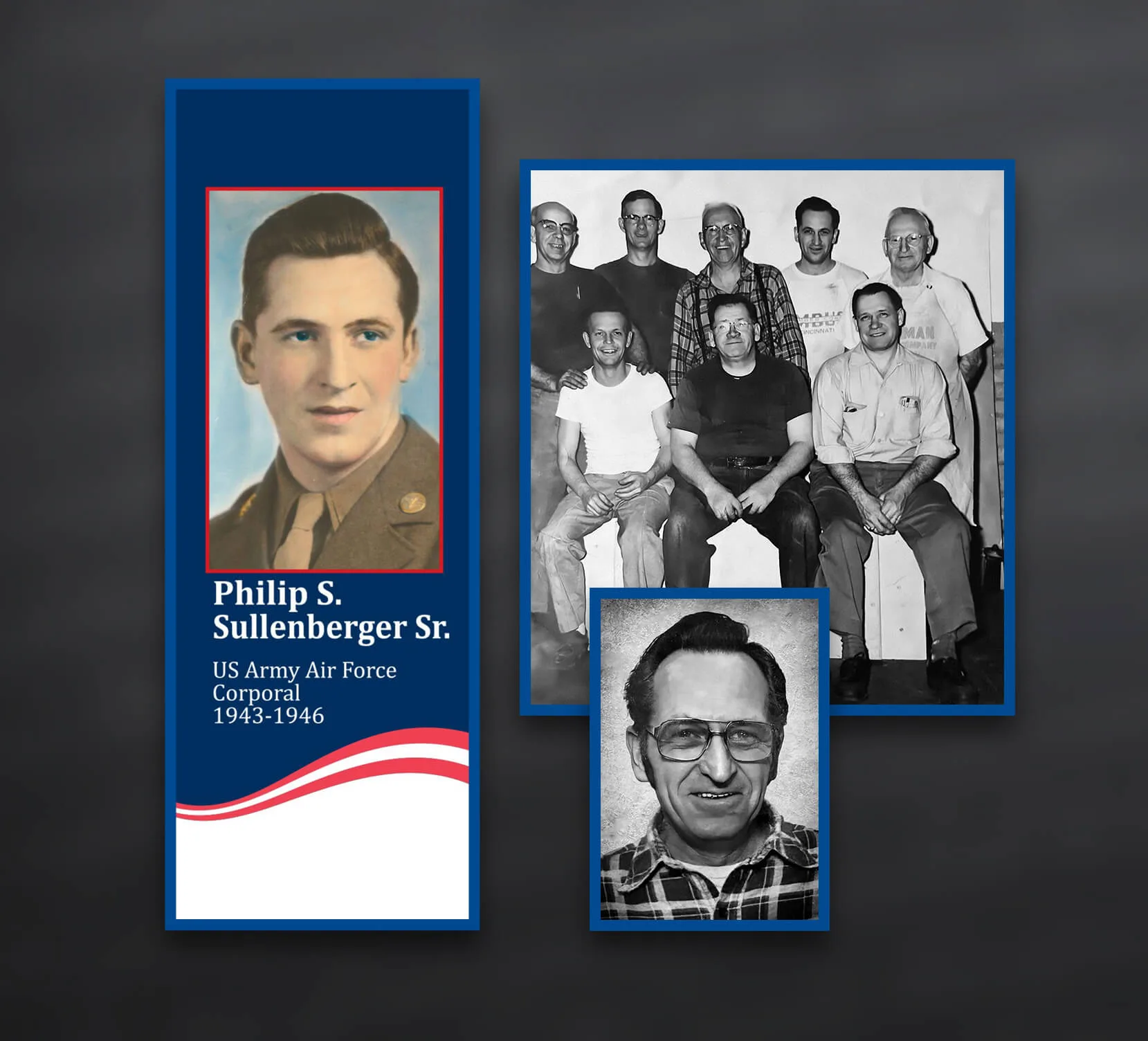
During times of war, French employees set down their tools and left the shop floor in Piqua for service around the world. The Roll of Honor displayed here records the names of those who served in the First and Second World Wars. The last names were added after 1945, and the roll has stayed as the company recorded it, a document of its moment. The company served too: in 1943 the federal government classified the plant as one hundred percent essential war work, and through the war years French built hydraulic press barrel straighteners and solvent extraction systems for naval and food production. Our gratitude does not stop where the roll does. It extends to every French employee who served in the conflicts since, to the veterans working throughout the company today, and to a partnership with the armed forces that never ended: French presses still shape components for aircraft, ground vehicles, and naval vessels. The entries that follow tell this story the way we prefer to: through people. A third-generation leader who taught special operations tactics before he ran the company. A father and son who served across two world wars and made patterns on our floor.
Roll of Honor Wood Case 1942.001.01 | DPF Medals Display 2025.061.01
Daniel P. French
Daniel Phelps French was born in Piqua in 1943, the year the federal government classified the French plant as one hundred percent essential war work. After graduating from Princeton in 1966, he served in the U.S. Air Force through 1971, earning the rank of Captain during the Vietnam War and teaching guerrilla warfare and intelligence tactics in a Special Operations unit. He remained in the Air Force Reserve until 1994, retiring as a Lieutenant Colonel with honors including the Meritorious Service Medal. In 1971 he came home to the company and started not in the front office but on the factory floor, as a machine tool operator. He became President in 1982 and CEO in 1985, and he led French into markets around the world. He died in 2023, after fifty-two years with the company. He served his country first, then the works his grandfather founded.
Metal Panel (Collages) – 2025.060.01

The Sullenberger Family
Frank Sullenberger and his son, Philip S. Sullenberger Sr., both served their country, and both came home to the pattern shop at The French Oil Mill Machinery Company. Frank served in the First World War with the 485th Aero Squadron in France, rising to Corporal in 1918 before his discharge in 1919. When the next war came he served again, in the Ohio State Guard from 1942 to 1943, while his son joined the U.S. Army, serving from 1943 to 1946. At French, Frank worked as a laborer and became a patternmaker. Philip Sr. made his name as a wood patternmaker, carving the exact wooden forms from which machine parts were cast; a pattern of their trade is displayed elsewhere in this museum. The photograph here was taken in 1951 or 1952 and shows father and son with their French team: two veterans, back row, side by side.
Metal Panel (Collages) – 2025.060.01
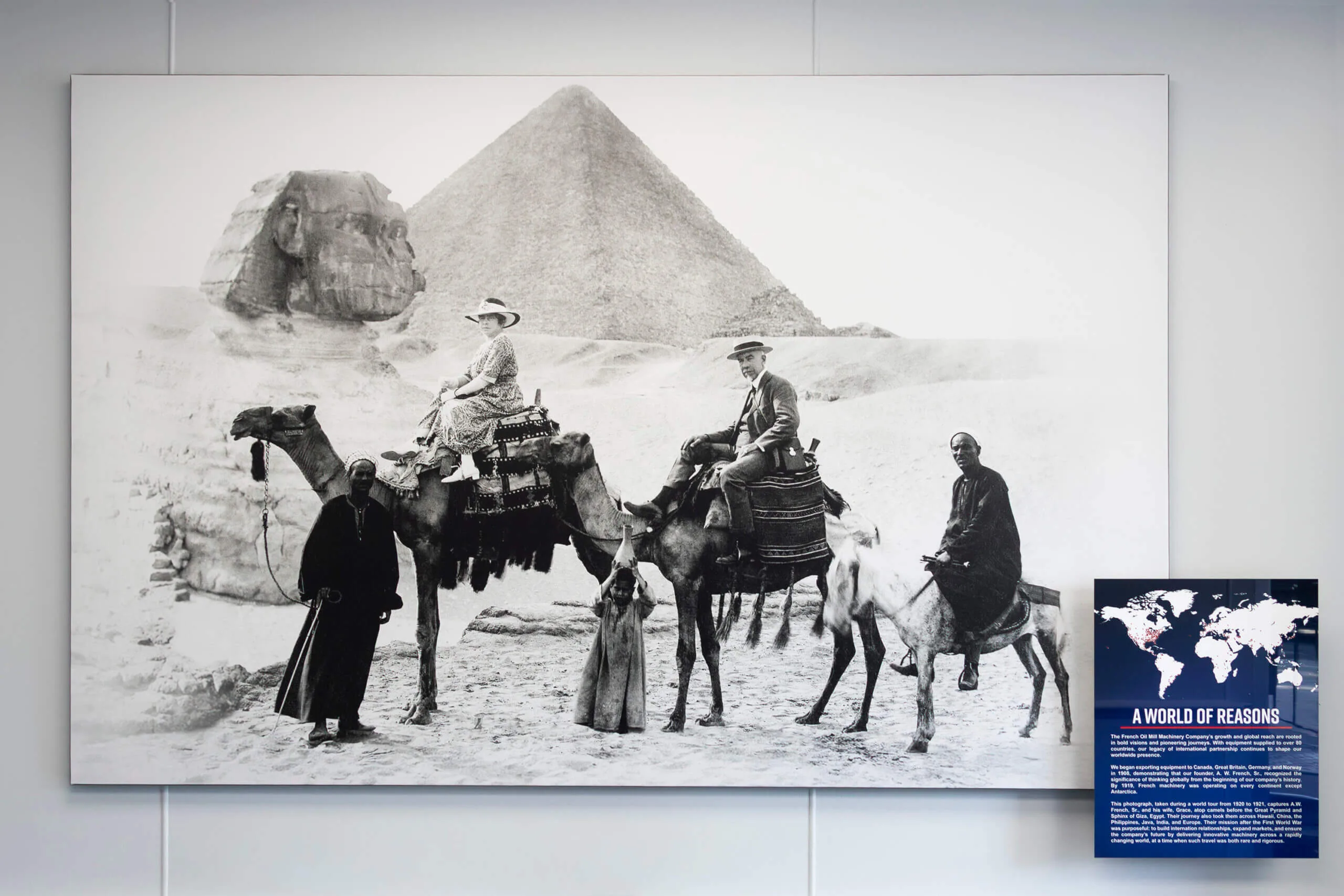
A World of Reasons: The 1920–1921 World Tour
The photograph on this canvas was taken in Egypt during the world tour Alfred W. French Sr. and his wife, Grace Albers French, made from 1920 to 1921: the founder of The French Oil Mill Machinery Company and the woman beside him, atop camels before the Great Pyramid and Sphinx of Giza. The trip was no vacation. After the First World War, the two set out to build international relationships and open markets for French machinery, crossing Hawaii, China, the Philippines, Java, India, and Europe at a time when such travel was rare and rigorous. They went because the company's future was overseas, and they went together. Alfred died four years later, in 1925. Grace took the presidency and held it for thirty-seven years, through the Depression and the Second World War. Look at the photograph again. The company's future is in it twice.
Egypt Canvas – 2025.001.01
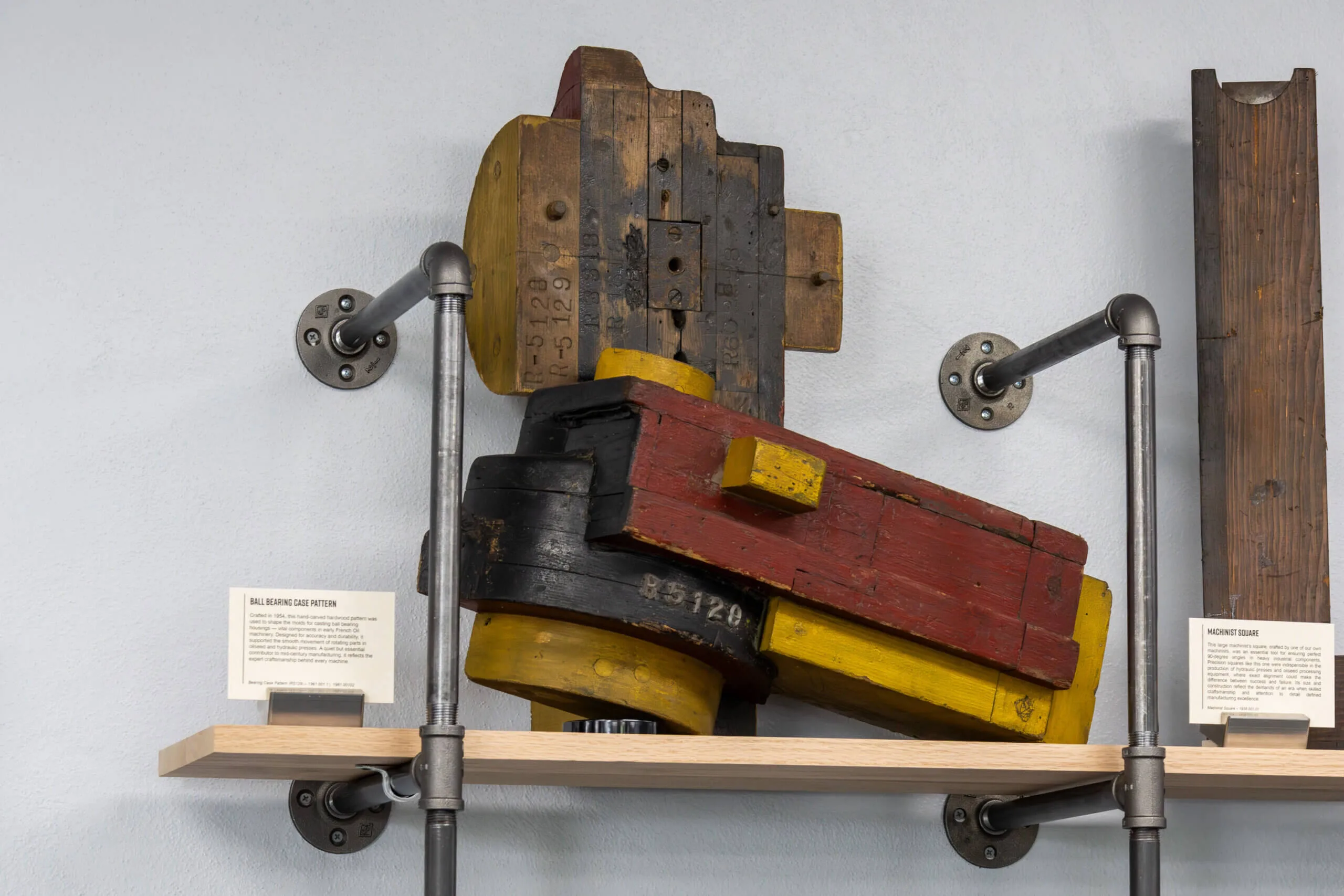
Ball Bearing Case Pattern
This hand-carved hardwood pattern, crafted in 1954, shaped the sand molds for casting ball bearing housings, the components that hold the bearings on which every rotating part of a press turns. A machine is judged by its stillness as much as its motion: a screw press shaft spinning under load runs true only if its bearings sit exactly where the pattern put them. The patternmaker's accuracy in wood became the caster's accuracy in metal, and the machine's smoothness in service. French oilseed and hydraulic presses ran on housings cast from this pattern.
Bearing Case Pattern (R5129) – 1961.001.01 | 1961.001.02
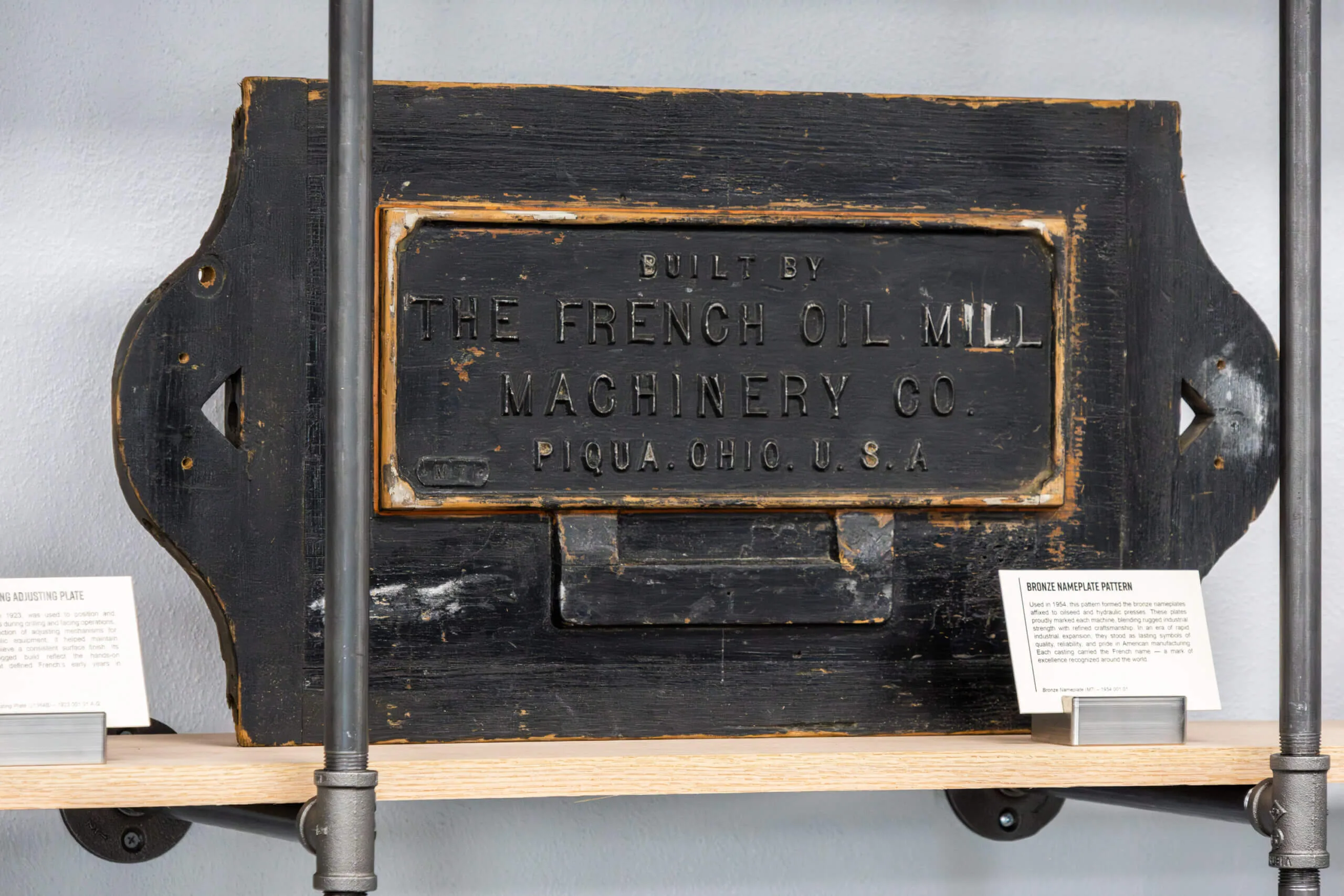
Bronze Nameplate Pattern
This pattern, marked M7 in the shop's tracking system, cast the one piece of a French machine that never did any work: the bronze nameplate. It was in use in 1954, shaping the molds from which the name of The French Oil Mill Machinery Company was poured in metal. Every press left Piqua signed. Bronze was the point: paint fades and paper labels fall away, but a cast plate lasts as long as the machine it names, and French machines were built to run for decades. A signature in bronze is a promise about the machine beneath it.
Bronze Nameplate (M7) – 1954.001.01
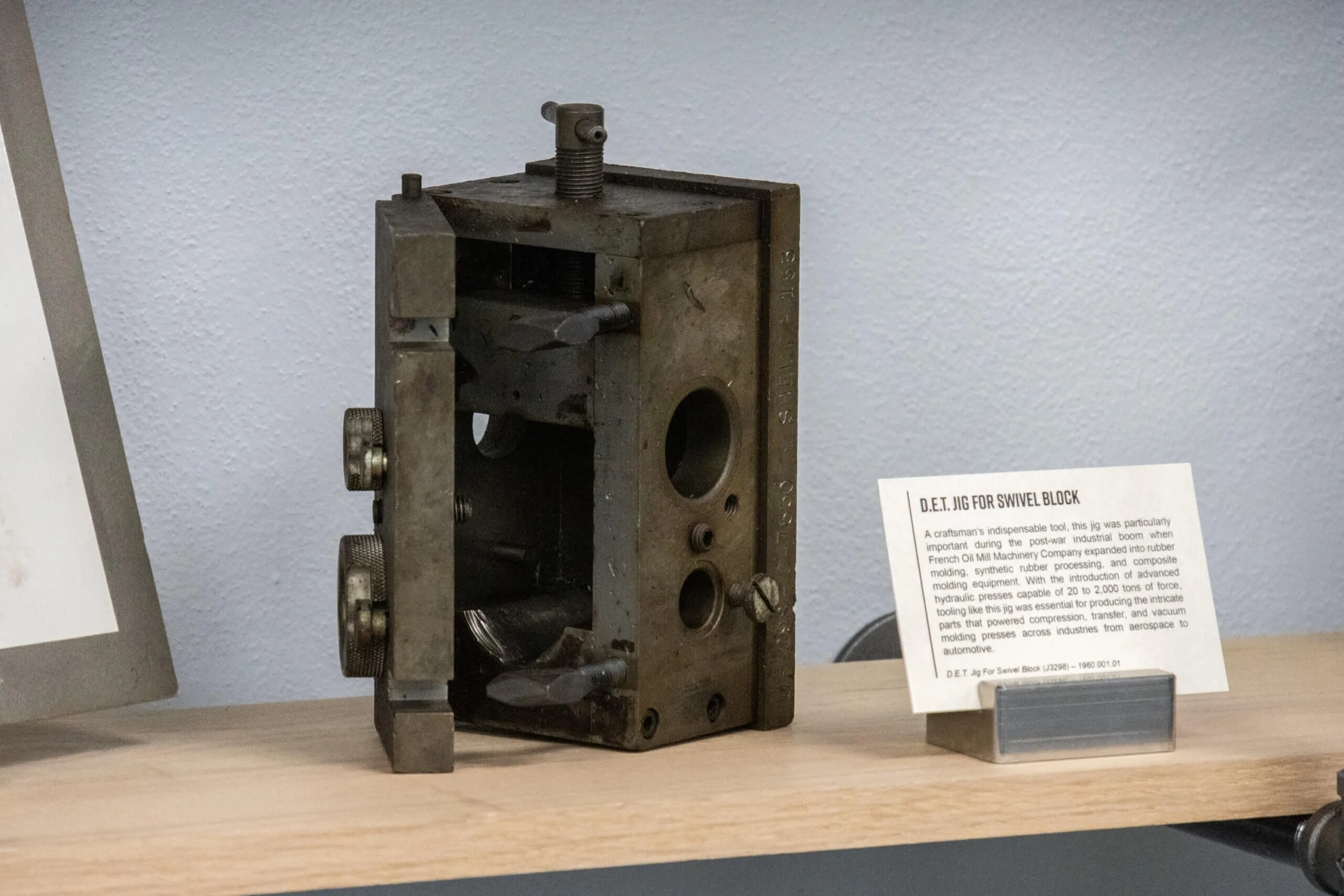
D.E.T. Jig for Swivel Block
This jig, numbered J3298 in the shop's tooling system, held swivel blocks in exact position for machining, so that every hole and surface landed identically, part after part. That repeatability is a jig's entire purpose: the skill goes into the tool once, and the tool spends it on every piece thereafter. This one earned its keep in the post-war boom, when The French Oil Mill Machinery Company expanded into rubber molding, synthetic rubber processing, and composite molding equipment, and its hydraulic presses ranged from 20 to 2,000 tons of force. Compression, transfer, and vacuum molding presses for industries from aerospace to automotive were built from parts made true the same way: a jig first, so the work could not wander.
D.E.T. Jig For Swivel Block (J3298) – 1960.001.01
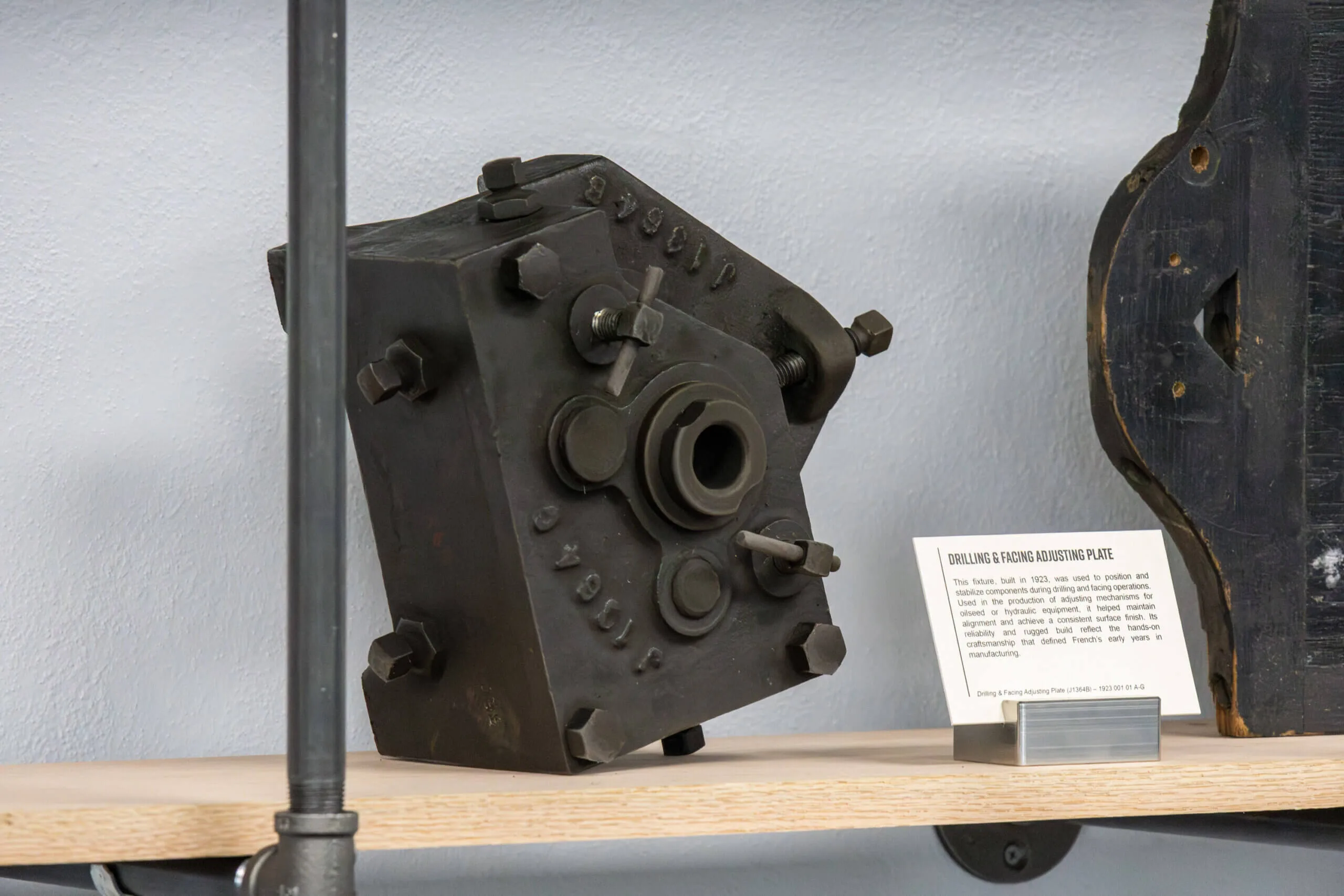
Drilling & Facing Adjusting Plate
This fixture, numbered J1364B and built in 1923, held components in position during drilling and facing operations, keeping alignment true and surface finishes consistent on adjusting mechanisms for French equipment. It is the earliest-dated tool in the collection, and it comes from a hinge point in the company's story. Two years earlier, vegetable oil prices had collapsed from thirty-six cents a pound to six, and French's customers stopped ordering; by 1922 the company had answered by building hydraulic presses for steel, die sinking, rubber, and bakelite molding. Whether this fixture served the oilseed line or the new press line, the record does not say. In 1923 the shop was busy becoming both, and the founder still walked the floor.
Drilling & Facing Adjusting Plate (J1364B) – 1923.001.01 A-G
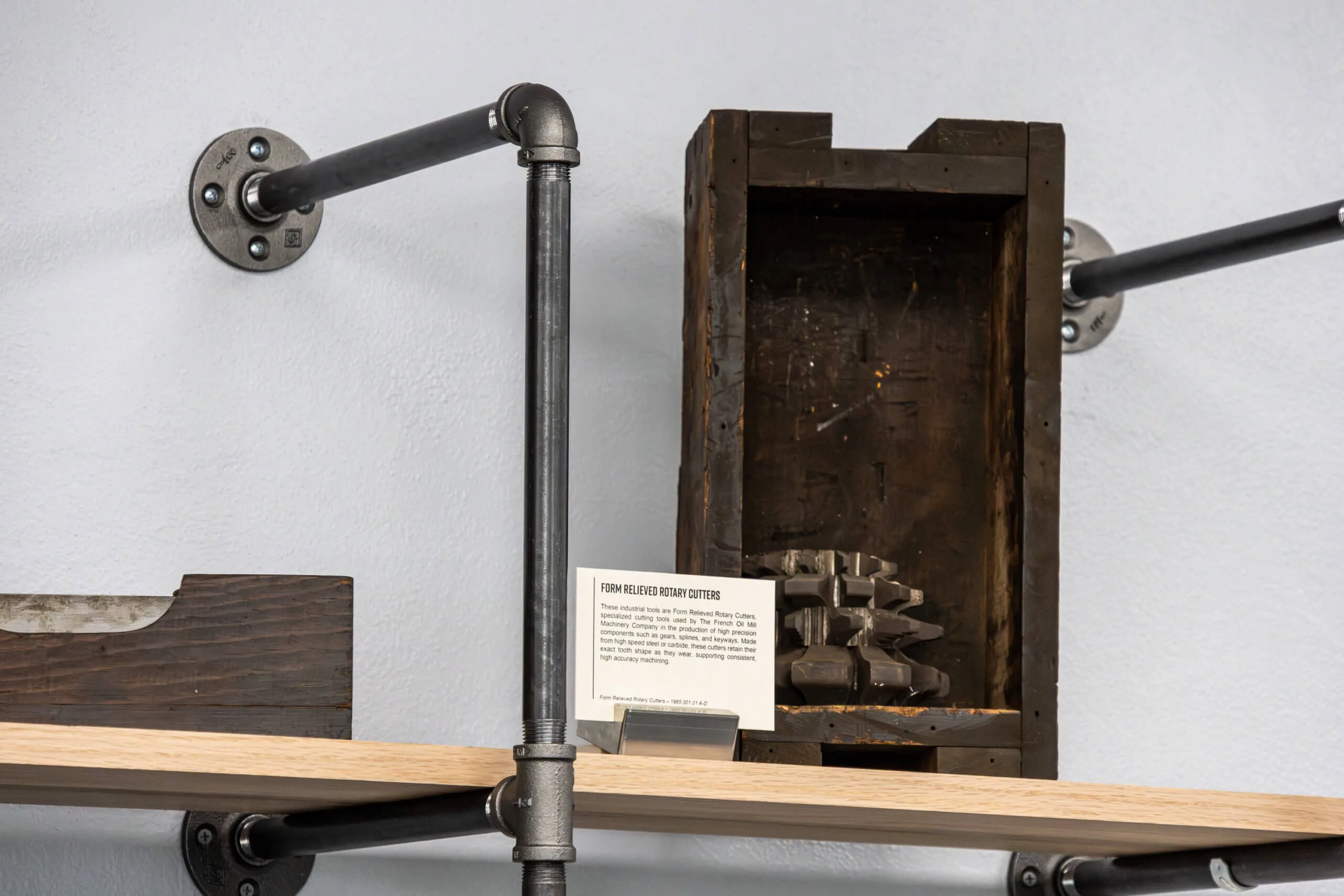
Form Relieved Rotary Cutters
These are form relieved rotary cutters, the tools French machinists used to cut high-precision features like gears, splines, and keyways. Their name is their genius: the cutter is ground with relief behind the cutting edge, so each resharpening restores a fresh edge without changing the tooth's profile. A cutter that holds its form holds its accuracy for its whole working life. Made of high speed steel or carbide, cutters like these shaped the gears and keyed shafts that carried power through French presses, cut after cut, year after year.
Form Relieved Rotary Cutters – 1965.001.01 A-D
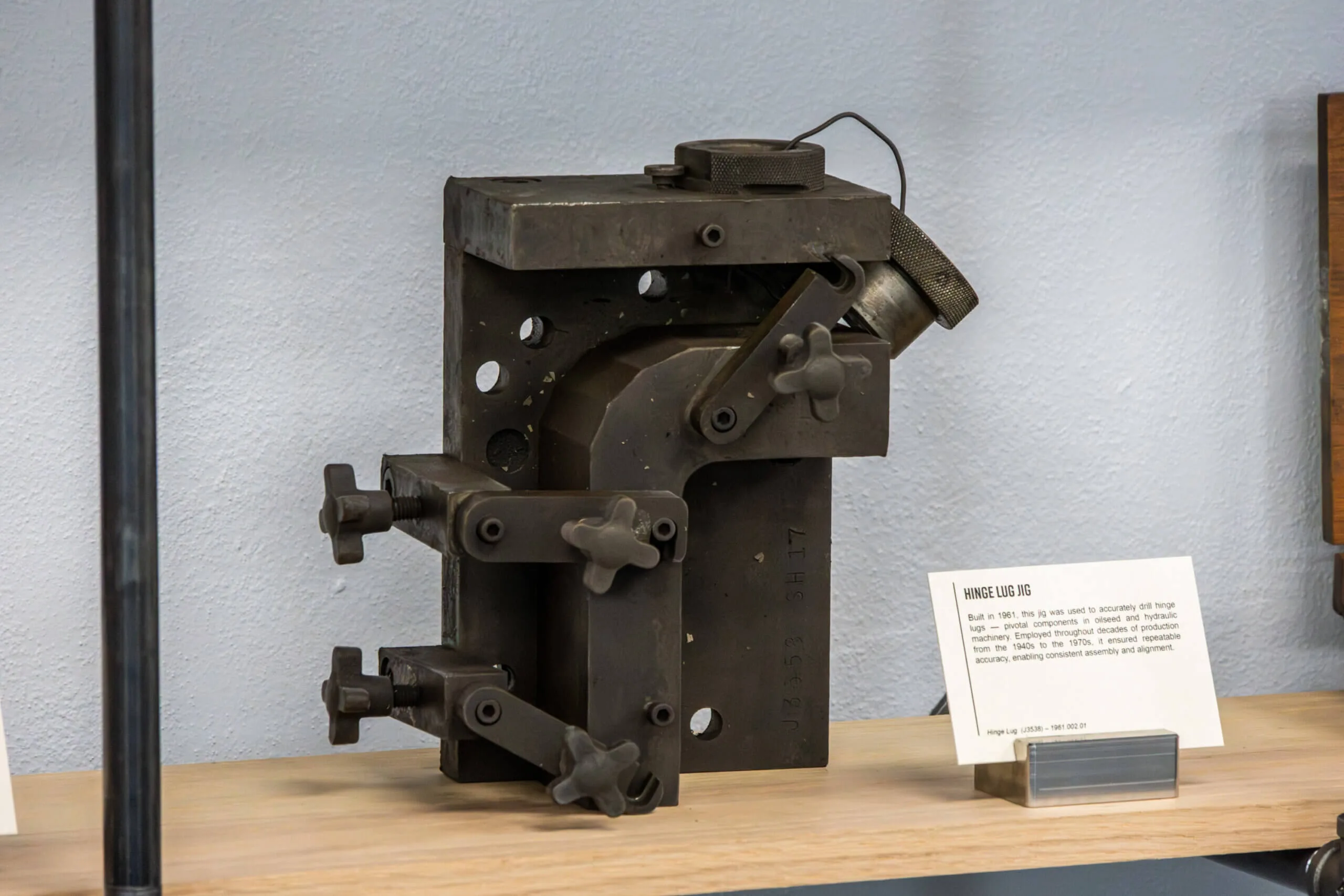
Hinge Lug Jig
This drill jig, numbered J3538 and built in 1961, guided the drilling of hinge lugs: the pierced fittings a hinge pin passes through, the pivot points of hinged press components. A lug drilled a few thousandths off does not merely fit poorly; it binds the whole hinge. The jig removed that possibility, hole after hole, part after part, through years of oilseed and hydraulic press production. Repeatable accuracy is not glamorous work. It is the reason assemblies built years apart still went together.
Hinge Lug (J3538) – 1961.002.01
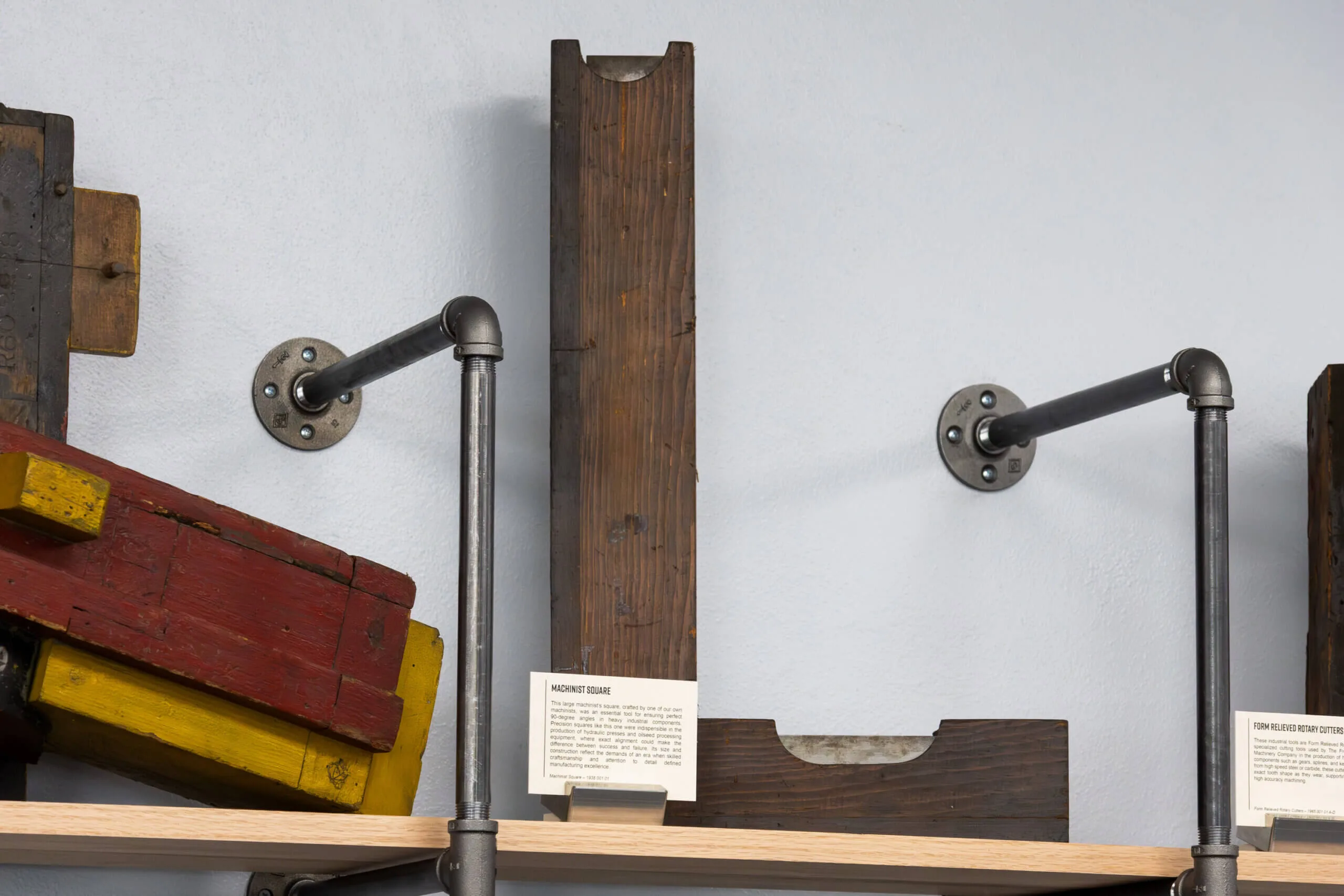
Machinist Square
This large machinist's square was made by one of French's own machinists, in the shop, for the shop. Its job was the right angle: proving that the heavy components of presses and oilseed equipment stood truly square, because a frame out of square does not merely look wrong, it binds, wears, and works against itself for the rest of its life. There is a quiet circularity in a tool like this: the shop built the square, and the square judged the shop's work, every day, for years. Whoever made it built the standard he would be held to.
Machinist Square – 1938.001.01
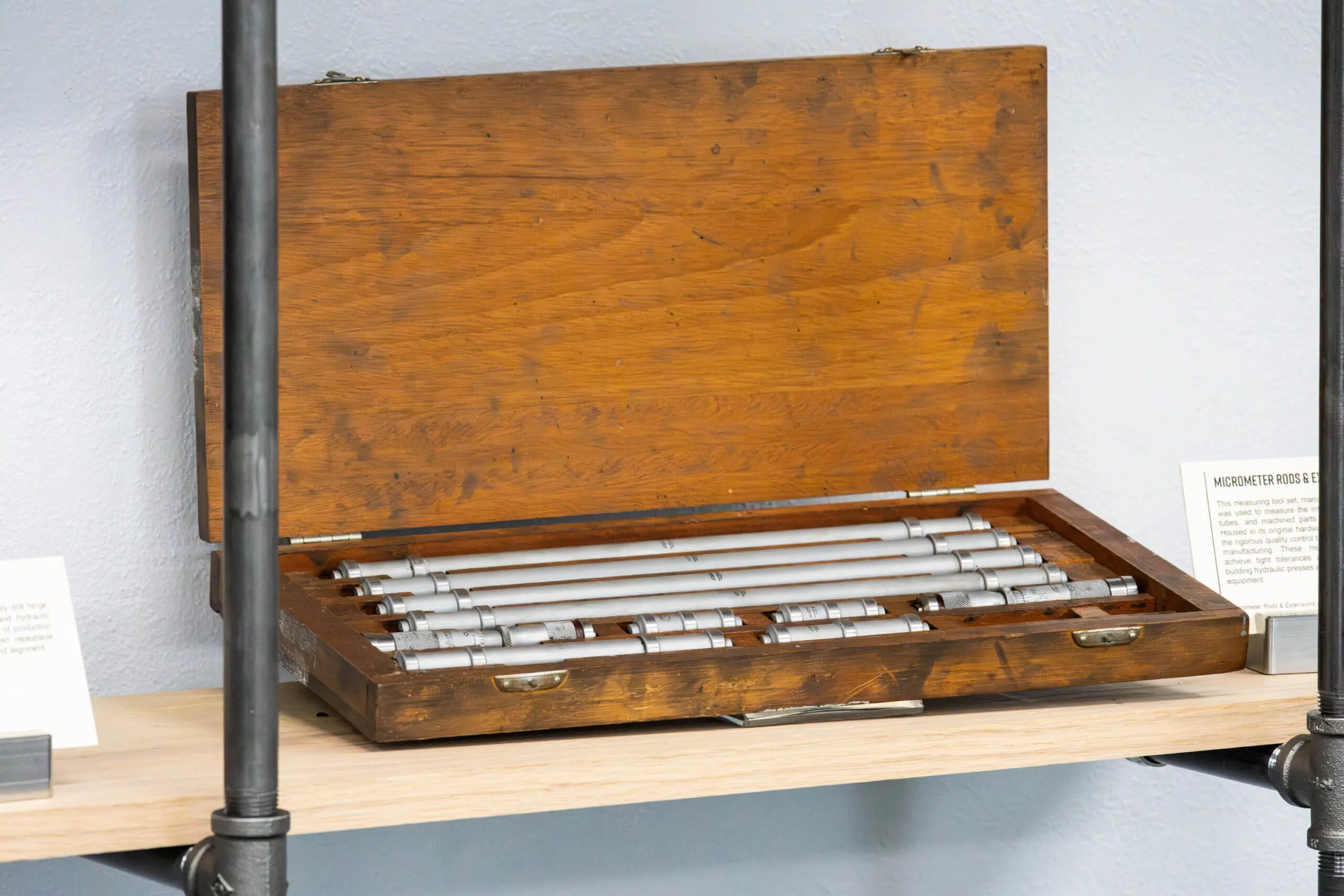
Micrometer Rods & Extensions
This set of micrometer rods and extensions was manufactured by Lufkin in 1963 and used at French to measure internal dimensions, bores, tubes, and machined openings, to tolerances measured in thousandths of an inch. On a hydraulic press, the dimension that matters most is one you cannot see from the outside: the bore the ram travels in. An inside micrometer is how a machinist knows it is right. The set still lives in its original hardwood case, because a precision instrument that gets dropped, dinged, or left in the sun stops telling the truth. The machinist's square elsewhere in this museum was made in the shop; these were bought from Lufkin. Some instruments you make, and some you buy. The shop knew which was which.
Micrometer Rods & Extensions – 1963.001.01
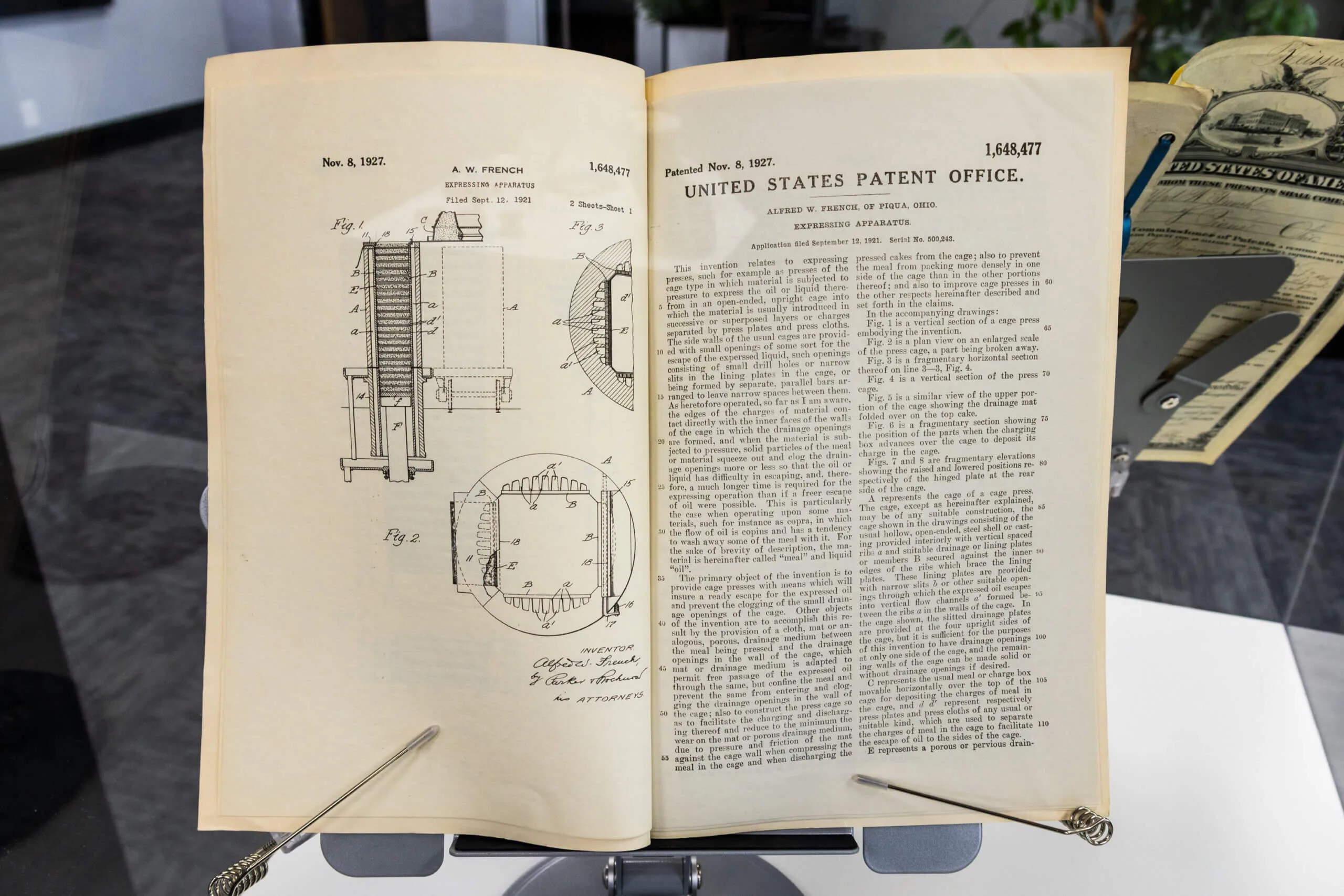
Variable Feeder Automatic Clutch Jig
This two-piece drill jig, numbered J2482, was built in 1943, the year the federal government classified the French plant as one hundred percent essential war work. The classification covered everything the shop made, and this jig made oilseed equipment: it guided uniform hole placement in production, standardizing in steel a step that would otherwise vary hand to hand and part to part. A jig is a decision made once and enforced ever after, and in 1943 the shop had no time to make the same decision twice. The urgency passed. The precision stayed.
Variable Feeder Automatic Clutch (J2482) – 1943.001.01 A-B